The lord who counts on his fingers
Kabuki has a famous scene in which a man does nothing but count on his fingers.
It comes in the second act of Matsuura no Taiko — “Lord Matsuura and the Drum of Chūshingura,” as the theatre’s own program renders the title. Lord Matsuura Shizunobu of the Hirado domain, hosting a haikai poetry gathering, notices a drum sounding from the residence next door. He counts the beats. He recognizes the drumming pattern of the Yamaga school of military science. And that can only mean one thing: the masterless samurai of Akō are, at this very moment, storming the house next door.
The actor stays seated and folds his fingers one by one. That is the whole scene — and the whole play rests on it.
I have seen this play three times.
- July 31, 2016 — Atsugi City Cultural Hall (Shōchiku Grand Kabuki eastern tour, closing day). Matsuura: Ichikawa Somegorō (now Matsumoto Kōshirō X)
- January 22, 2017 — Kabukiza, New Year program, evening. Somegorō again
- September 21, 2019 — Kabukiza, Shūzan-sai program, evening. Matsuura: Nakamura Karoku
That last performance was a memorial production marking 100 years since the death of Nakamura Karoku III — the actor who made this role his own. Nakamura Kichiemon I inherited it from him and enshrined the play in the Shūzan Jisshu, the “Ten Best Plays” gathered under his pen name Shūzan — the same name the September Shūzan-sai festival carries. The role comes with a line of succession, and the current Karoku was stepping into it.
I will be honest: the first time, I did not really get it. I could not follow the plot, did not know where to look, and was not much moved.
The second time was at the Kabukiza, with the same actor in the same role. Same play, same lead — but the theatre had changed, and the play looked different. It was distinctly better.
It finally clicked on the third viewing, with Karoku as Matsuura. By then the plot and the high points had settled into place for me, and a veteran’s seasoning landed on top of that. My way of watching had finished forming, and a performance arrived that answered it. I think that was the actual sequence.
And once I could see the play, the finger-counting scene became my favorite. The lord counts happily. It is a moment when tension should run through the room — the raid has begun — and he cannot hide his delight. With every beat he folds a finger, wearing the face of a man whose long-awaited moment has finally come.
I had seen Kanadehon Chūshingura [The Treasury of Loyal Retainers] as a three-month full-length production at the National Theatre, all the way to the raid. So when Matsuura no Taiko clicks into place as a side story of Chūshingura, knowing where it sits in the larger tale makes it land harder.
(Whether I can be straightforwardly moved by the raid itself is another matter. It is, after all, a story of forty-seven men banding together to go and kill a man. Loving the play and endorsing the deed have stayed separate things for me.)
There is one more reason this play became a favorite. Its setting is where I live. I will save that for the end.
The whole play stands on one word: “next door”
The plot runs like this.
The day before the raid, on Ryōgoku Bridge in the snow, the haikai master Takarai Kikaku runs into Ōtaka Gengo — a former Akō retainer, now reduced to peddling susudake — long bamboo poles, their top leaves left on, sold for sweeping the year’s soot from the rafters. Kikaku offers a verse: “The year comes to its rapids — as water flows, so flow the lives of men.” (The Japanese for “year’s end,” toshi no se, is literally the year’s rapids: the water image begins inside the word itself.) Gengo caps it — “And tomorrow, the long-awaited treasure ship” — and walks away.
(Let me say it now: this meeting never happened either. More on that below.)
The following night, a poetry gathering is under way at Lord Matsuura’s residence. As a student of Yamaga Sokō’s school he has championed the Akō men all along, and their failure to act has him irritated. Kikaku recites yesterday’s exchange. And then — a drum sounds from the house next door.
The entire play, in other words, is built on a single premise: Matsuura’s residence stands next to Kira’s. If they are not neighbors, the drum cannot be heard. If the drum cannot be heard, there is no finger-counting scene.
So — where was this house next door?
Crossing Ryōgoku Bridge
The opening act is set on Ryōgoku Bridge, so that is the natural place to start walking.
One thing first, though. The bridge you cross today is not the bridge Kikaku and Gengo stood on.
The Edo-period Ryōgoku Bridge stood downstream of the present one. When it was rebuilt as an iron bridge in 1904 it moved about 50 meters upstream, and when the present bridge was built in 1932 it moved roughly another 20. The figures vary from source to source, so I will not add them up — but the direction is beyond doubt: the Edo bridge was downstream of today’s.
What set this off was a disaster. On August 10, 1897, the railing of the wooden bridge collapsed under the crowds out to see the fireworks, with many dead and injured. Edo’s busiest amusement quarter — the bridge and the open firebreak plaza at its foot — was rebuilt precisely because of its own crowds, and the location moved with it.
One more thing. The kiriezu — the sectional maps of Edo — mark this bridge as “96 ken long,” about 174 meters. That is longer than today’s bridge (164.5 meters). The river itself has narrowed.
The meeting that never was
At the foot of the bridge stands a stone monument: the Ōtaka Gengo haiku monument, erected in 1928. (The stone writes “Gengo” with a variant second character — a distinction that romanization erases, so I note it here.)
It stands at the east end of the present bridge, beside the steps down to the Sumida River Terrace, just short of the elevated expressway. It is one of three monuments in a row, next to a bronze relief of Hiroshige’s One Hundred Famous Views of Edo: Ryōgoku Bridge and the Great Riverbank and a tall war memorial. Two lines of cursive script, with archaic kana, on a rough-split natural stone. There is no explanatory signboard.
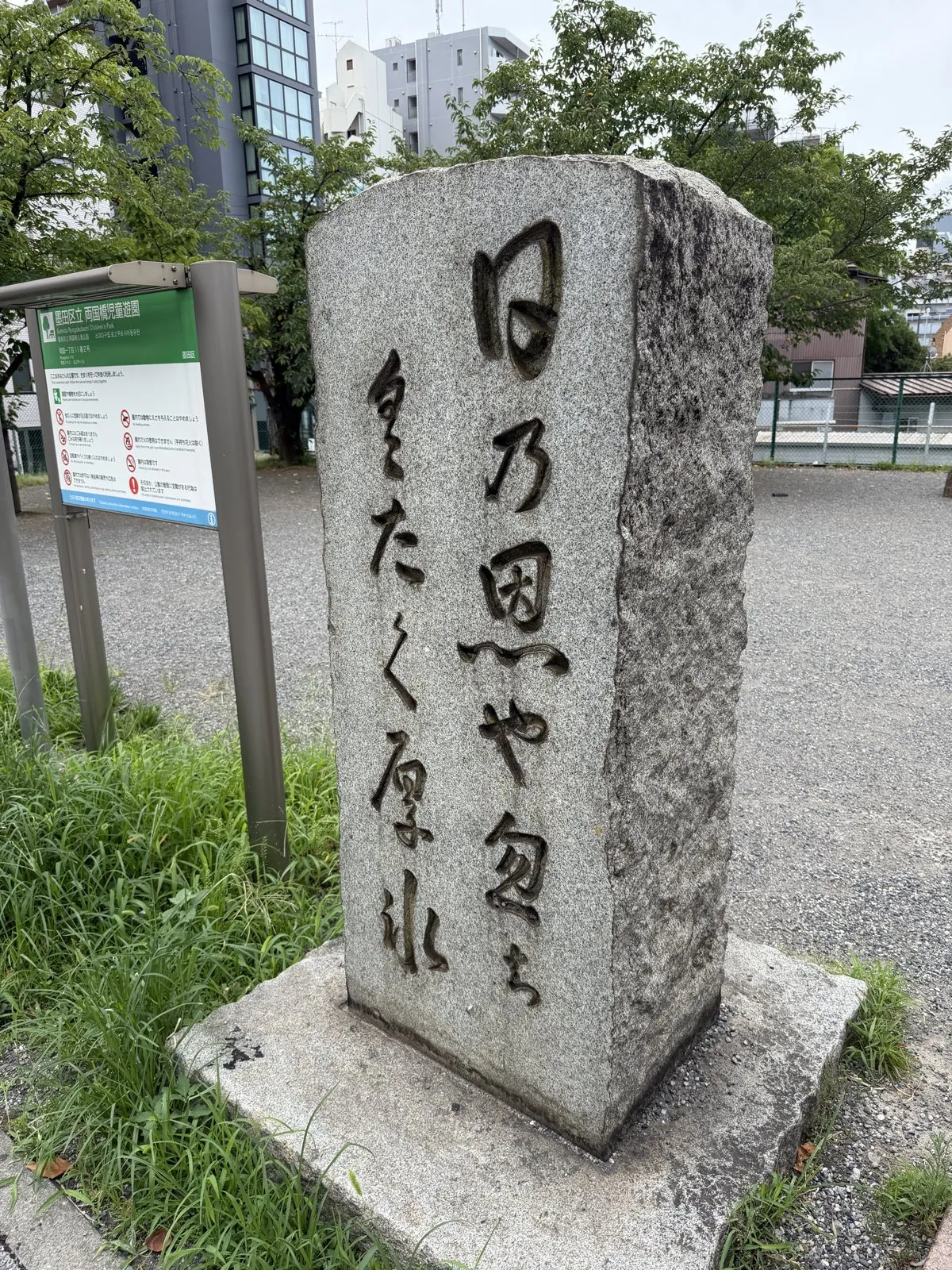
The Ōtaka Gengo haiku monument at the east end of Ryōgoku Bridge. The only verse carved on it — “The sun’s grace: thick ice, shattered in a moment” — carries no author’s name. Photographed August 2026
But when I looked into it, the meeting itself turned out not to be historical.
There is no record that Ōtaka Gengo ever studied under Kikaku in Edo, and the encounter on Ryōgoku Bridge is a later invention — that is where the trail of evidence ends. The source of the fiction has even been identified: it appears to stem from Iroha Bunko, a popular novel by Tamenaga Shunsui. A library reference service checked four references and reached the same answer: all treat it as a story made up after the fact.
Look closely at the stone, too. The verse carved on it — “The sun’s grace: thick ice, shattered in a moment” — is not the “treasure ship” verse exchanged on the bridge in the play. It is a different poem, said to have been composed after the raid. And it carries no author’s name.
Sumida ward’s own description hedges: “a haiku said to be by Ōtaka Gengo.” One reference calls it “the haiku monument attributed to Ōtaka Gengo.” Nobody commits.
So this is the situation: a monument commemorating a meeting that never happened has stood, since 1928, on the spot where the meeting is said to have taken place. The play predates the monument by more than two hundred years.
To be honest, I walk past this monument almost every week. It is on my neighborhood route.
I had passed it countless times without knowing what it was. I had even stopped there. But the eye goes to the tall war memorial beside it — that one you cannot miss. Next to it, a small rough-split stone.
I realized what that stone was during the desk research for this article. Something I had always walked past connected itself to the play I was studying. It startled me.
Incidentally, in Edo, “Ryōgoku” meant the west end of the bridge — today’s Higashi-Nihonbashi, in Chūō ward. The east side, today’s Ryōgoku in Sumida ward, was “Honjo-Ryōgoku” or “Ryōgoku across the river.” Today the name belongs to the east side. Here too, Edo and the present have traded places.
A fraction of 2,550 tsubo
Cross the bridge and walk about seven minutes east and you reach Honjo Matsuzakachō Park — the site of Kira’s residence.
A small enclosure ringed by a black-and-white namako wall sits wedged between houses and office buildings. According to the signboard on site, Kira’s residence measured 72 ken east-west by 35 ken north-south — 2,550 tsubo, about 8,400 square meters. Today’s park is one eighty-sixth of that.
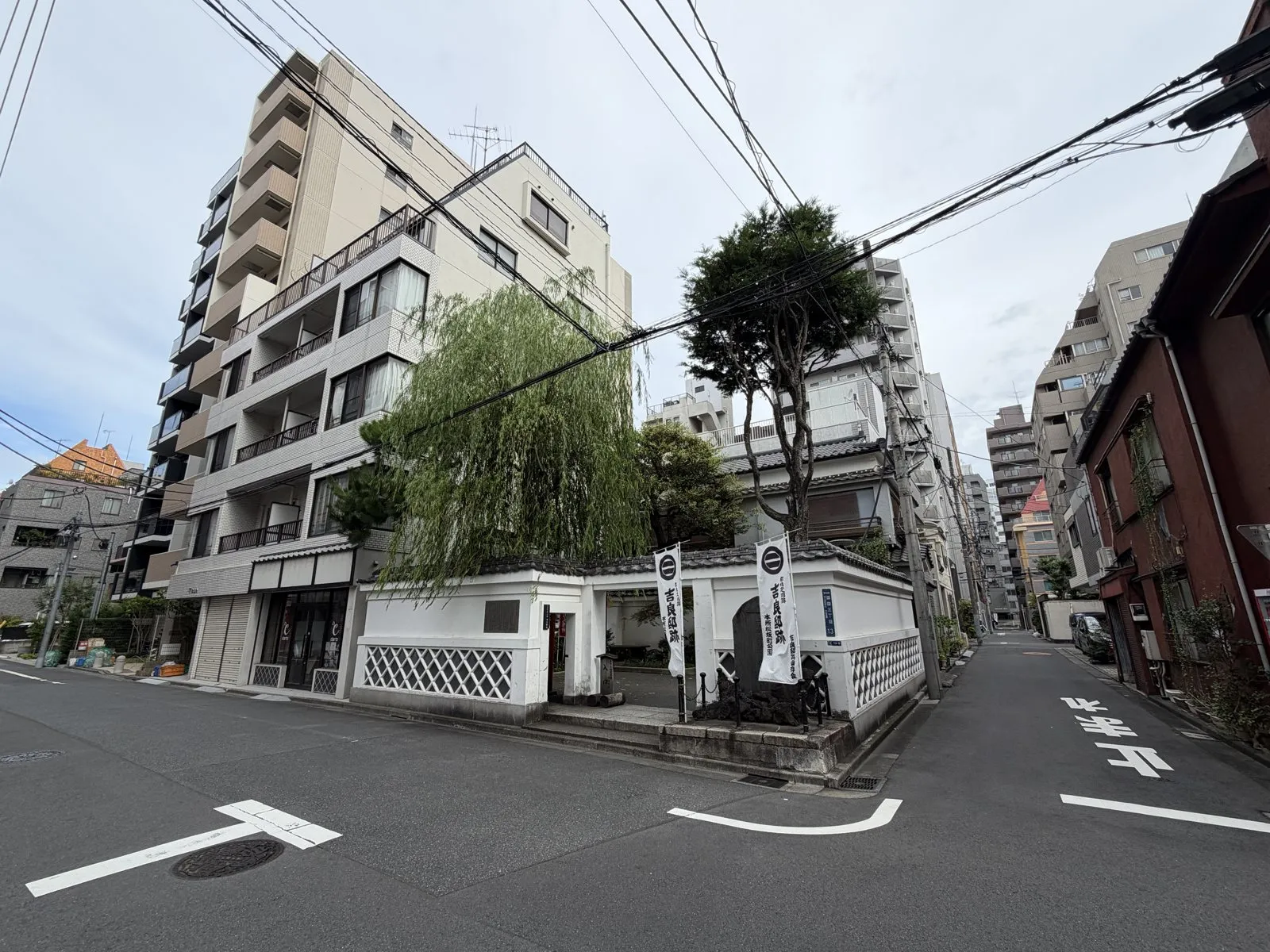
Honjo Matsuzakachō Park, the site of Kira’s residence. Of 2,550 tsubo, this corner is all that remains. Photographed August 2026
Do the division and it checks out. The park’s area is about 98 square meters (the ward’s plaque says “97.56 square meters”). Not 97 tsubo. 97 square meters.
But it is the park that is small, not the residence.
What tells you the original scale stands outside the park. Sumida ward has placed a “Site of the main gate of the Kira residence” board about 60 meters east of the park, and a “Site of the rear gate” board about 80 meters west. Between the two boards: roughly 140 meters. Against the “72 ken east-west” (about 131 meters) on the signboard, the order of magnitude agrees.
The famous two-pronged attack — the Akō men splitting between main gate and rear gate — was a matter of this distance. Twenty-three men through the front, twenty-four through the rear. From inside the namako wall, you cannot see that.
One practical note: a memorial festival (Gishisai) is held here every December, and the neighborhood draws crowds as the anniversary of the raid approaches. Worth keeping in mind when you plan a visit.
The actual neighbor to the north was somebody else
Leave the park and walk north.
The man who actually lived north of Kira’s residence was a hatamoto — a direct retainer of the shogun — named Tsuchiya Chikara (Tsuchiya Michinao, 3,000 koku). Not Lord Matsuura. The two properties did not even share a wall; a passage is said to have run between them.
On the night of the raid, Tsuchiya sent a messenger to report the incident to the shogunate, and told the inspecting officials that “the intruders looked to be fifty or sixty men, all dressed as if for a fire” — this much is historically documented. The famous embellishment — that he sided with the raiders, hoisting lanterns high over the fence with archers posted beneath them — comes from the Confucian scholar Muro Kyūsō’s Kyūsō Shōsetsu, and its credibility has been questioned (the historian Mitamura Engyo rejected Tsuchiya’s involvement outright).
In other words, the story that “the lord next door took the raiders’ side” likely already contains a layer of dramatization. Kabuki and kōdan storytelling even have a separate piece, Tsuchiya Chikara, with Tsuchiya himself as the hero. The same framework exists in parallel versions with different protagonists — which tells you that “the lord next door” was a vessel of a role, waiting for someone to be put into it.
So: is there anything in the neighborhood today that marks Tsuchiya Chikara?
About 130 meters north of the park stands a stone monument — but it is the “Site of Honjo Matsuzakachō” monument, erected in 1932 by the neighborhood association mourning the loss of the old town name in 1929. It commemorates the town, not the Akō affair. Turn east from there and you come out in front of Ryōgoku Elementary School, where a literary monument to Akutagawa Ryūnosuke stands — he studied at this school.
Sumida ward has papered this district with numbered explanatory boards in several series — “Chūshingura,” “The Towns of Edo,” “Ryōgoku Stories.” A dozen or more in this area alone. There is a board at the former house site of one of the forty-seven rōnin. There is even a board at the training-hall site of Tawaraboshi Genba — a fictional character who appears in no account of the raid; the board itself politely tells you he is fictional.
There is no board for Tsuchiya Chikara.
To be fair: the Edo sectional map reproduced on the Kira-site signboard — the Owariya Seishichi edition — has the names of the samurai estates adjoining Matsuzakachō to the north printed right on it. The Tsuchiya and Honda parcels exist within that figure. The text never mentions the name, but in the map, he is there, next door.
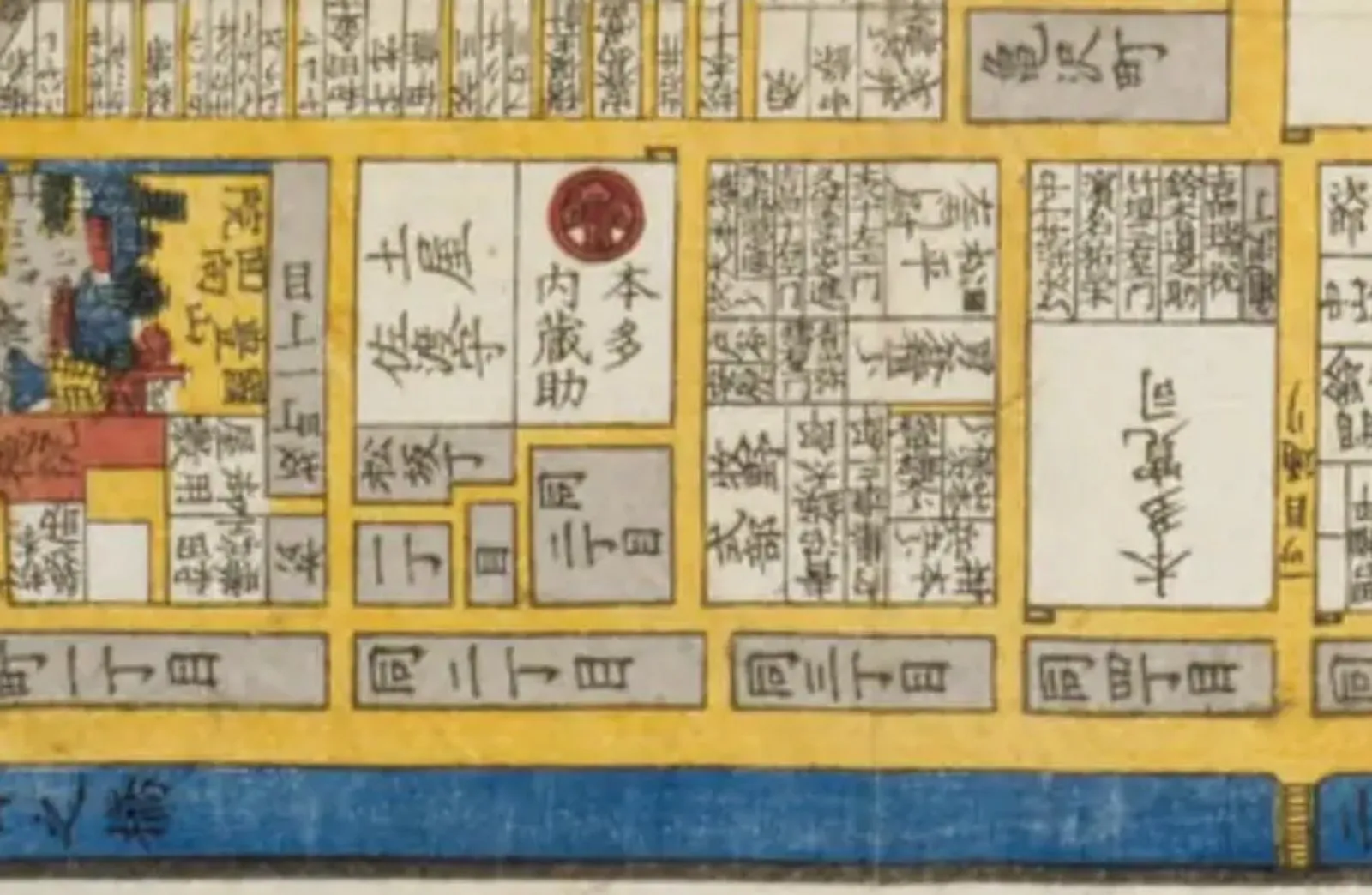
North of Matsuzakachō (gray = townhouse blocks) lie the samurai parcels of the Tsuchiya and Honda families. Kira’s residence was confiscated in 1703 and so does not appear on this map. Honjo ezu, from the Edo kiriezu series (Owariya Seishichi, 1849–1862). Reproduced from the National Diet Library Digital Collections (out of copyright, Public Domain Mark) dl.ndl.go.jp/pid/1286679
I walked the streets looking — the street just north of the park, and the next one over. That is where the historical neighbor must have lived.
There is no marker to be found.
If it is not there, it is not there. Still, I keep wanting to find something.
A war drum does not carry across a river
So where was Lord Matsuura’s residence?
On the other side of the Sumida River.
The Hirado domain’s kami-yashiki — a daimyo’s principal residence in Edo — stood at Torigoe in Asakusa (now the grounds of Shinobugaoka High School, Asakusabashi 5-1-24, Taitō ward). From Kira’s residence that is about 1.5 kilometers in a straight line, across the river — a walk of more than twenty minutes.
The bukan of 1789 — the published directory of daimyo households — likewise places the Hirado principal residence at “Kami-Asakusa Torigoe.” The “house next door” that the play posits never existed.
No drum carries that far.
I will confess something: I had always thought this play was exactly that story — the story of a war drum carrying all the way across the river to the Matsuura residence.
So my first reaction was: “surely that is too far.” I have known this distance for years. Across Ryōgoku Bridge and on to Asakusabashi. No drum could possibly be heard.
That the play itself says “next door” — I only learned that when I began this research.
Which means I had been believing a version set even farther away than the play’s. The play had pulled the residence within earshot; I had left it where it really stood and believed the drum carried anyway. Both versions ignore the river.
I stood on the bridge. The morning was overcast, with a breeze unusual for August, and cool. It was early, and the boats passing below were working boats, not tour boats.
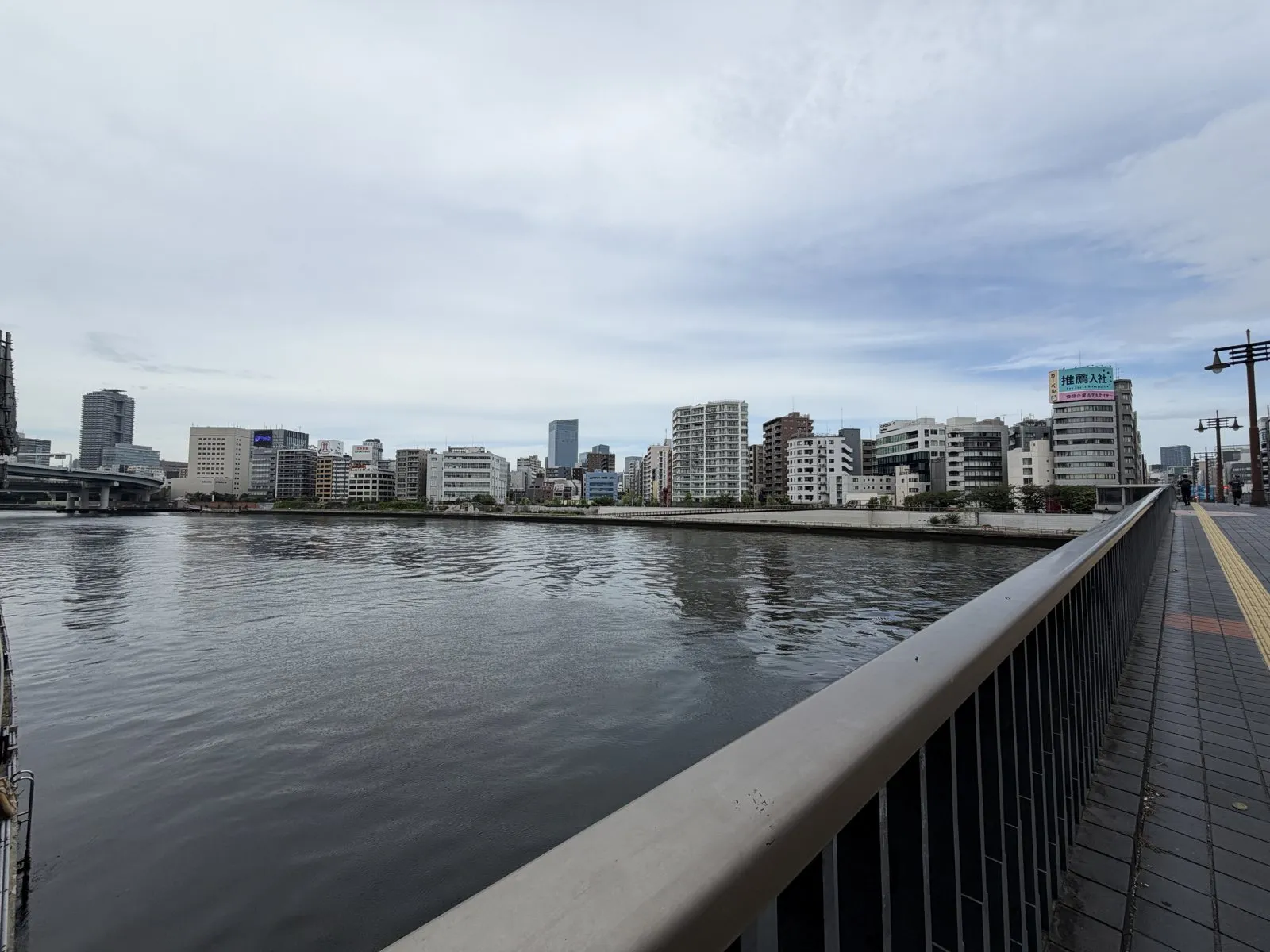
The Sumida River from the east end of Ryōgoku Bridge, on the morning of August 11, 2026
This river is still working. It is not something you can ignore.
Why Matsuura, then?
If the article stopped here, it would amount to “the play differs from history.” The interesting part is the next question: why was the entirely unrelated Lord Matsuura summoned into the story?
I think the answer is that the requirements of the role came first, and the person was chosen afterward.
The play’s centerpiece is a man identifying a drum by its pattern of beats. The character must be someone who could plausibly do that — a daimyo trained in military science. The Matsuura family of Hirado kept the Yamaga school of military science as its house learning. The family’s tie to Yamaga Sokō is historical fact — there is even a record of the garden’s embankment being rebuilt in stone “according to Yamaga Sokō’s principles of fortification.” This was a house whose military science reached into its garden.
Onto this, a Meiji-era circumstance was layered. Under the Tokugawa shogunate, real incidents could not be staged as themselves — hence Kanadehon Chūshingura transposing the whole affair to the Kamakura period. When that constraint fell away, the house that best fit the casting requirement — “a lord who can read a war drum” — was Matsuura.
The current Matsuura no Taiko took shape through Meiji-era revisions of an 1856 one-act staged at the Moritaza in Edo. In 1882, Nakamura Karoku III played Matsuura Shizunobu at the Kado no Shibai in Osaka. A 1900 Osaka production, Matsuura Jindaiko, is the direct source of the current play; Kichiemon I inherited Karoku III’s signature role and fixed it in the classical repertoire among the Shūzan Jisshu.
When a play chooses a place or a person, what it needs is not fact but the conditions under which the role works. Lord Matsuura was summoned because he met the conditions.
And yet it is not pure invention either
Here I want to be precise.
The Matsuura family did keep a residence in Honjo — a shimo-yashiki, an outlying villa.
During the great Edo fire of 1806, the daimyo of the day — Matsuura Kiyoshi, better known by his pen name Seizan — took refuge at “the Honjo residence.” Maps from the 1830s–40s show both the principal residence and the villa of the Hirado domain.
And there is a signboard at that site too.
About 620 meters north of the Kira site — a walk of under ten minutes — stands a board in Sumida ward’s “Ryōgoku Stories” series. Its own English title reads “Former Mansion with the Chinkapin Tree of Unfallen Leaves.” A Matsuura daimyo residence stood in this area, the ward writes.
But what the board relates is a ghost story. The garden had a magnificent chinkapin tree, yet no one had ever seen it drop a leaf — “the leafless chinkapin,” one of the Seven Mysteries of Honjo. That, the board says, is how the Matsuura estate came to be called the Chinkapin Residence (Shii-no-ki yashiki).
The forty-seven rōnin do not appear in it. Neither does the title Matsuura no Taiko. Nor any mention of where Kira’s residence stood.
The name Matsuura did survive in Honjo — in an entirely different context. Just as the play summoned Lord Matsuura to play the neighbor, the gossip of Edo had summoned the same family into quite another role.
The timing problem remains, though. The Honjo residence can only be confirmed from the nineteenth century onward; there is no evidence of one at the time of the raid — the twelfth month of Genroku 15, which falls in January 1703 by the Gregorian reckoning. The record comes more than a century after the raid. And 620 meters is not next door — nor within earshot of any drum.
So the conclusion stands: “the Matsuura residence next to Kira’s” is the play’s invention. But if you wrote “the Matsuura family had nothing to do with Honjo,” that would be wrong too.
Force everything into true-or-false and something slips through. What this land holds is a truth displaced in time. The play’s lie may not have been conjured out of nothing after all.
In the corner of a school ground
Finally, back across the river to Asakusabashi.
On the site of the Matsuura principal residence — the real “Matsuura residence” — now stands Shinobugaoka High School. Here there was once a garden called Hōraien: 2,500 tsubo of garden within a 15,000-tsubo estate, counted alongside Kōrakuen and Rikugien among the three great gardens of the capital.
It was laid out in the 1630s under the direction of Kobori Enshū and others. At first it was a secondary villa, not the principal residence — but when the then-principal residence burned in 1641, this estate was promoted the following year. The Eikitei pavilion. The inlet called Bōchō no Irie — “tide-watching.” The hill called Irokayama. Every view in the garden had its own name.
Among them was Matoniwa-no-hara — “the field of targets.” The Asakusa Ward Gazetteer of 1914 writes of this spot: “here, in former times, the military arts were practiced.” The garden contained a training ground. Being a house of the Yamaga school reached all the way into the garden — the premise of a lord who can read a war drum is not pure invention either.
What I find most interesting: this garden was not built on cleared ground. The same gazetteer writes that the northeast part of the garden “falls where the old Ōshū highway once ran through Torigoe village.” A set of six Jizō statues bears a date of 1574; a stone pagoda attributed to the 1394–1428 period had a hackberry tree growing from its top, and was said to be the remains of a highway milestone mound.
Things that had stood there for decades before the garden existed were kept, as they were, and made into views. The garden was layered — names and all — on top of the land’s memory.
The garden itself was ruined in the Great Kantō Earthquake of 1923, and in 1937 the grounds were filled in for a school. Three hundred years of history end there.
What remains today: a great ginkgo in the northeast corner of the school ground, and a small fragment of the pond once called Bōchō no Irie.
The ginkgo is a Tokyo Metropolitan natural monument (designated 1956), about 21.3 meters tall with a trunk circumference of about 4.8 meters. The signboard states the tree “was here from the garden’s beginning.” If the garden dates from 1632, this tree has stood here close to four hundred years.
The garden was buried; the pond and all thirty-six named views are gone. Only the tree remains.
One caution. Both the ginkgo and the pond are inside the school grounds. You cannot walk in. The interior can be seen only during school events, or by properly arranging use of the facilities (the tennis courts, for instance). On an ordinary day, you look up at the tree from outside the main gate. It is worth looking up at even so.
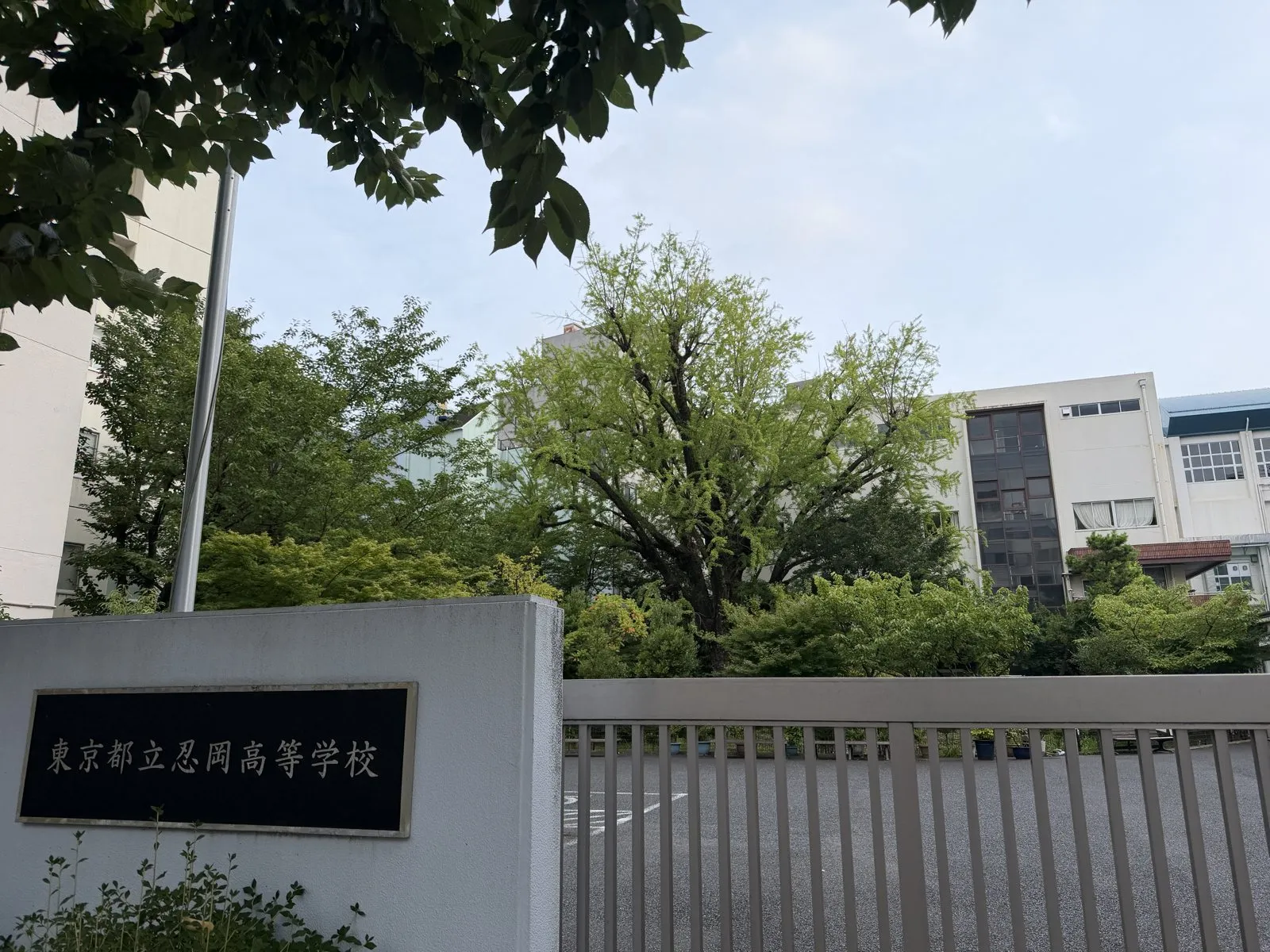
The great ginkgo from outside the main gate. The grounds are closed to visitors, so this is the viewing spot. Photographed August 2026
The Tokyo Annai guide of 1907 and the Asakusa Ward Gazetteer of 1914 both carry photographs of Hōraien before it was lost — a pavilion overhanging the water, the wide pond, the groves on the far bank. Both volumes can be viewed in the National Diet Library Digital Collections (out of copyright).
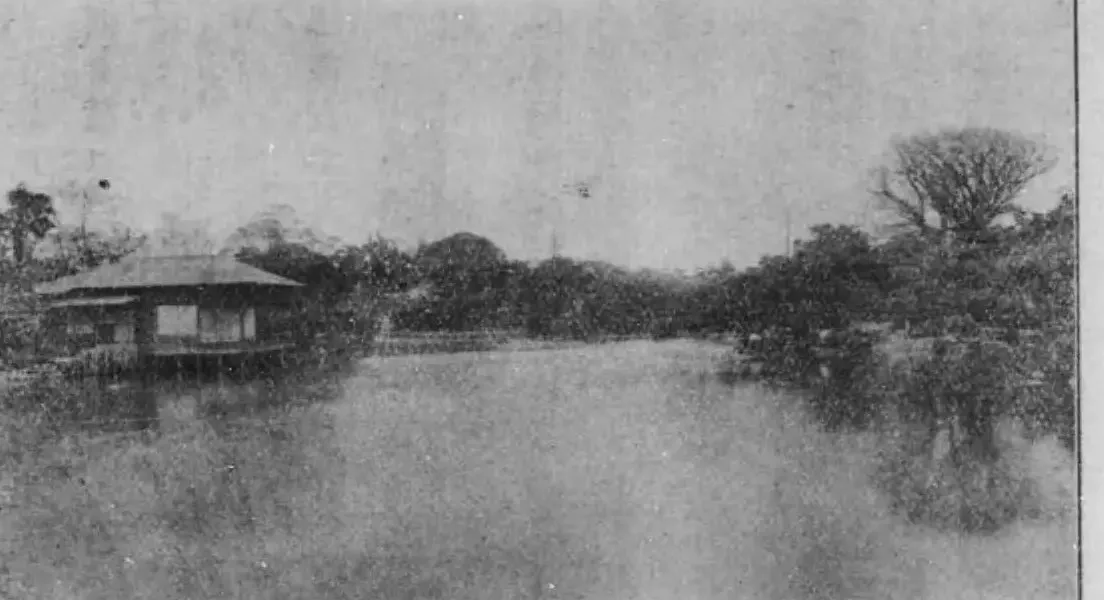
Hōraien before it was lost; at left, the pavilion overhanging the water. From the Asakusa Ward Gazetteer, vol. 1 (Asakusa Ward, 1914). Reproduced from the National Diet Library Digital Collections (out of copyright, Public Domain Mark) dl.ndl.go.jp/pid/950733
Every weekend, in the garden’s footprint
There is something I have kept back until now.
This is my neighborhood.
Ryūhoku Park, which occupies part of the Hōraien site, is where I take my child almost every weekend. There is a slide, there are benches, the local kids run around.
You cannot see the great ginkgo from the park — the school building stands in between. But I pass the main gate nearly every day, and from there it is visible. On weekdays, I see a four-hundred-year-old tree daily.
The order of discovery was backwards, too.
I knew this had been a famous Edo garden before we even moved here — because a stone monument carved “Site of Hōraien” stands on the grounds. The land came first; the play arrived later.
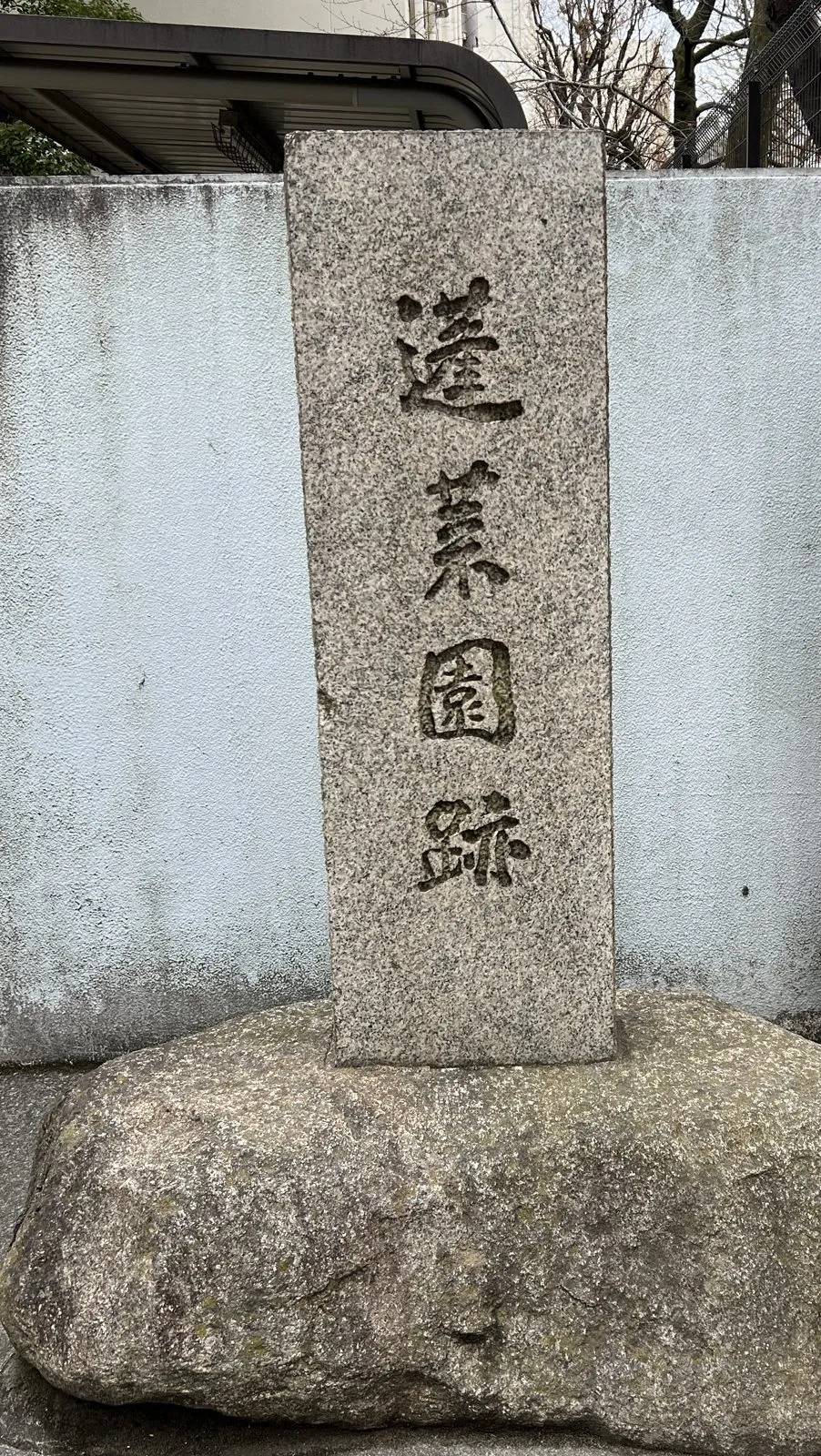
The “Site of Hōraien” monument. Photographed January 2023
I watched the play three times, did the research, walked Ryōgoku, crossed the river — and the “real Matsuura residence” at the end of that road was a park I had known all along.
If Matsuura no Taiko has become a special play for me, this is probably why. The setting was not somewhere unknown.
Has the park changed for me? Not really. The slide is still a slide. But now I push my child on it thinking: this is where Matsuura no Taiko is set.
On the lord who was not next door
Cross Ryōgoku Bridge, stand at the Kira site, confirm that no marker names Tsuchiya Chikara to the north, cross back over the river to Asakusabashi. Over a half-day’s walk, the play and the historical record trade places again and again.
The play placed a lord next door who was never there. The historical neighbor has no signboard. The real residence is now a high school, and the garden’s remnant is a playground. The Chinkapin Residence board to the north introduces the Matsuura family only through a ghost story.
Count it up and this play stacks lie upon lie. The opening meeting: invented. The house next door: invented. The lord who hears the drum: an unrelated man. And yet a haiku monument stands at the foot of the bridge, and a namako wall still rings the park. The lies came first, and the land came chasing after them.
One more thing worth recording.
After the raid, the Akō men did not cross Ryōgoku Bridge.
At the foot of Ichinohashi, the bridge over the Tatekawa canal, a signboard states this was the first bridge the men crossed on their withdrawal (the board cites no source, so I can write no more than “so it is said”). From there they rounded to Eitai Bridge and walked to Sengakuji temple in Takanawa. The bridge the play chose for its opening scene is one the men themselves never crossed.
I have not walked that route yet. It is close to ten kilometers. When the weather cools, I intend to.
Even so, the joy of the counting scene is real. A lord learns the raid has begun next door and cannot hide his delight as he folds his fingers. A hundred and forty years of performances have made that lie true.
I used to think a pilgrimage meant traveling somewhere far away. Apparently not.
There is such a thing as too close to home. Still — living on the site is not bad.
To live in Tokyo is to live on top of Edo. A famous garden’s pond was filled in for a school ground, with a single tree left in the corner. I walk past a monument to a meeting that never happened, every week. History did not end up in a display case: life keeps going on top of it.
This weekend, most likely, I will be at that park with my child again.
Getting there
This section exists only in the English edition (see STRATEGY §8.5: practical information for visitors).
- The walk in this article runs from Ryōgoku Bridge east to the Kira site, then back across the river to the Hōraien site near Asakusabashi. The actual walking is modest — Hōraien site to Kira site is about 30 minutes at an easy pace. Give it half a day only if you stand in front of everything, the way this article does.
- Nearest stations: Ryōgoku (JR Sōbu Line / Toei Ōedo Line) for the bridge and the Kira site; Asakusabashi (JR Sōbu Line / Toei Asakusa Line) for the Hōraien site.
- Coming from the Kabukiza: the Toei Asakusa Line runs direct from Higashi-ginza to Asakusabashi; you can walk this route in reverse. Asakusabashi and Ryōgoku are close enough that no train is needed between them — walk it, over Ryōgoku Bridge. Crossing that bridge on foot is rather the point of this article.
- What is physically left is modest — a stone monument, signboards, a walled corner of a park, one very old tree. This article is the context that makes them worth standing in front of. That is the deal, stated up front.
- The Hōraien remnants (ginkgo and pond) are inside an operating high school and not open to walk-ins; view the tree from outside the main gate. In December, the Kira site area gets crowded around the Gishisai memorial festival.
Sources (4)
The sources are those of the Japanese original, which this article was translated from; see the Japanese edition for the full list (theatre programs of 2017-01 and 2019-09; the 1789 bukan; the Tokyo Annai of 1907 and Asakusa Ward Gazetteer of 1914 via NDL Digital Collections, both out of copyright; Sumida ward signboards photographed and transcribed on site, 2026-08-11; and the research notes in research/notes/).
Translation notes (differences from the Japanese original, per research/eigo-yakugo.md):
- Dates before 1873 are lunisolar-calendar years; where the Japanese edition writes 元禄15年(1702)for the raid, this edition adds that the raid month falls in January 1703 Gregorian. (Even the theatre’s own program wavers here: its 2017 English synopsis dates the raid “1703, by the Western calendar,” while the 2019 edition gives 1702. The two reckonings coexist at the source — which is exactly why this edition spells the conversion out.)
- Traditional units are kept as romanized units with metric in parentheses (ken, tsubo), never converted to feet.
- The stone monument’s variant spelling of Gengo(源五/源吾)cannot survive romanization; noted inline instead.
- The linked verses on the bridge are translated by this site. The English synopsis in the theatre program was consulted to confirm the reading only — including the pun on se — and its wording is not reproduced, per this site’s rules on program text. The monument’s verse is not part of the play, so no program rendering exists; that translation is this site’s own as well.