It bends
Dote-dōri is a road I have taken many times. I also knew, from the map, that a bending road leads off it at the Yoshiwara-ōmon crossing and joins the streets of the Yoshiwara — once Edo’s yūkaku (a licensed pleasure quarter). But I had never gone in. To be honest, the occasion never came up.
Still, I had always wanted to go in, just once. Somewhere past that bend is the setting of the kabuki play Sukeroku. It’s the feeling of history joining up that I love.
On the morning of August 11, 2026, I rode up to that crossing on my bicycle. The first thing I saw was the Mikaeri-yanagi (Willow of regret). Plenty of old buildings. Look back, and there is the Skytree. Excited, I made the turn.
The road in from the Yoshiwara-ōmon crossing is not straight. It bends — gently, and for a long way.
That bend was put there on purpose. And the name of whoever had it bent is on record — only, different books give different names.
From the Mikaeri-yanagi
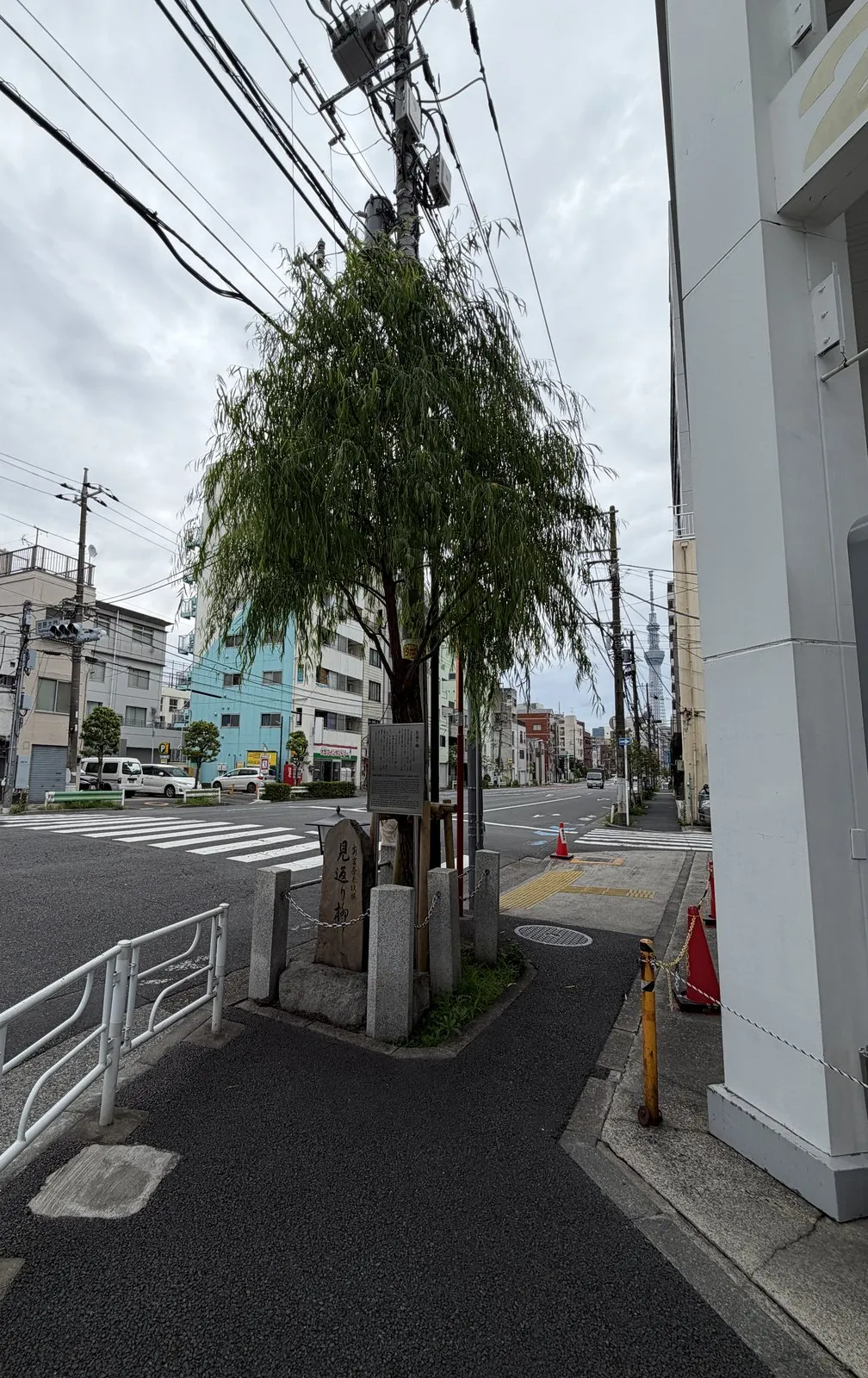
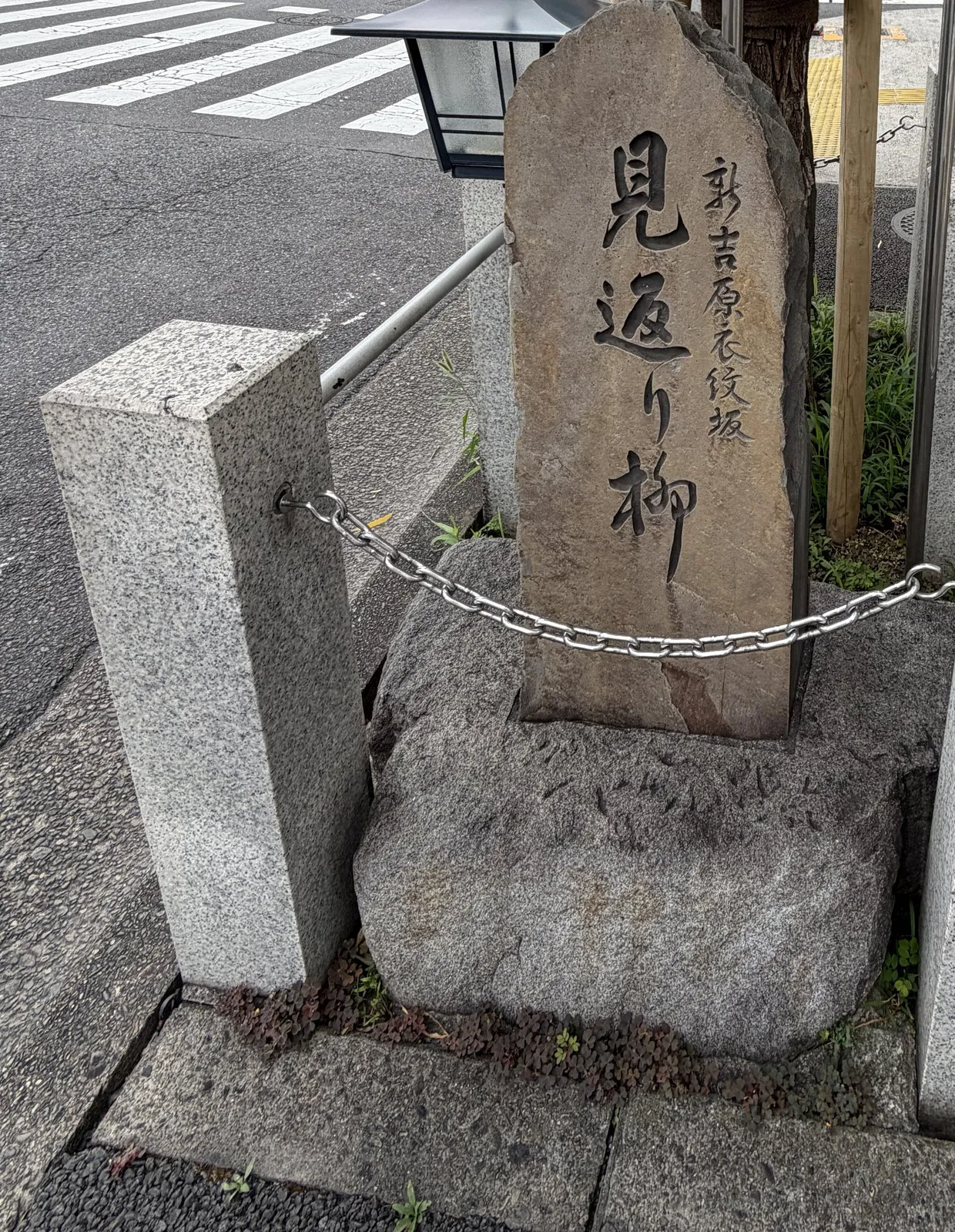
The Mikaeri-yanagi and, at its foot, the stone carved “Shin-Yoshiwara, Emon-zaka, Mikaeri-yanagi” (photographed August 11, 2026). The stone carries the name Emon-zaka.
The Mikaeri-yanagi stands at Senzoku 4-10-8, Taitō ward, along Dote-dōri.
But neither the tree nor the spot is the original. It was moved when the roads were rebuilt and the land replotted, and it has been replanted over several generations after losses in the earthquake and the war (Taitō Ward Board of Education signboard).
The Meiji-era Yoshiwara Enkakushi gives the origin of the name:
At the foot of the slope stands a single willow. Gallant men, leaving by the gate at the morning’s parting, come as far as here and, still lovelorn, turn to look back behind them — and so it is called the Mikaeri-yanagi. — Yoshiwara Enkakushi, p. 38 (1891)
Mikaeri means “looking back.” It is the willow where departing visitors looked back. Not on the way in — on the way out.
The Nihon-zutsumi: not a road built for the quarter
Dote-dōri, where the willow stands, follows the line of an old embankment — dote means embankment — called the Nihon-zutsumi.
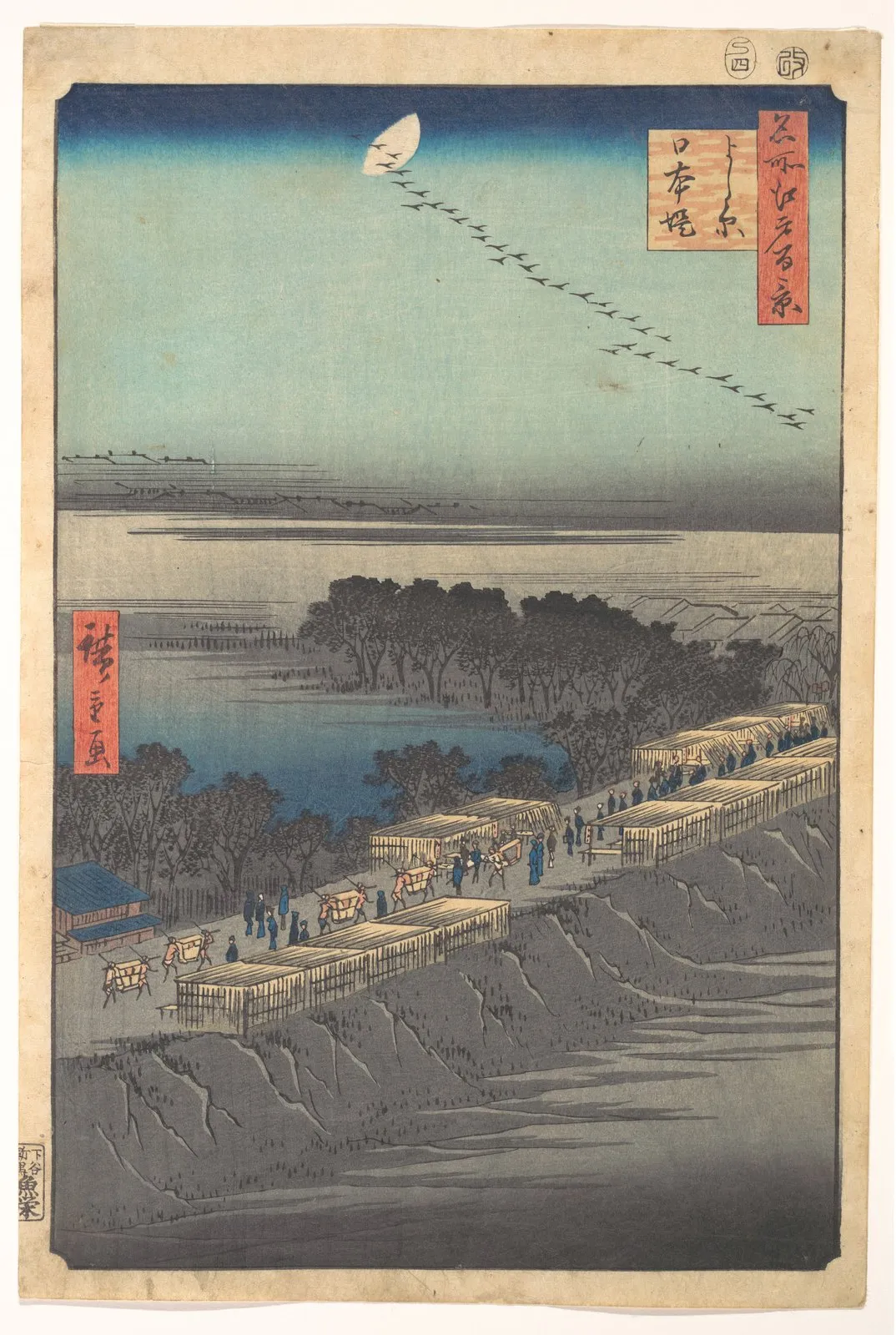
Utagawa Hiroshige, “Nihon Embankment at Yoshiwara,” from the series One Hundred Famous Views of Edo, Ansei 4 (1857) / The Metropolitan Museum of Art, Open Access (CC0) accession JP2514 (objectID 56931). Teahouses line the top of the embankment and palanquins come and go. The slope in the foreground shows how high the embankment stood. A willow is visible at the far right.
The embankment was not built as a road to the quarter. A signboard dates it to “Genna 6 (1620), 37 years before Shin-Yoshiwara was established.” Its purpose was to protect Asakusa and Shitaya, then low, marshy ground, from the floods of the Sumida River (Sanyabori Historical Tour signboard). A flood-control embankment became, later, the road to the quarter.
But the signboard gives no source for that year. The oldest account I have been able to find is in Edo Kagai Enkakushi (1894):
This embankment was built in Genna 6, thirty-eight years before Shin-Yoshiwara moved here. — Edo Kagai Enkakushi, p. 31
The year of construction, Genna 6 (1620), matches. The gap does not: the signboard says 37 years, the book 38. Count from Genna 6 to Meireki 3 (1657), the year Shin-Yoshiwara — the “New” Yoshiwara — moved here, and you get 37.
Almost none of the height in the print survives on today’s Dote-dōri. Still, as the name Emon-zaka on the willow’s stone tells you, this was a place where you went down.
Emon-zaka: the slope for setting yourself right
The slope down from the embankment is called Emon-zaka — emon is the set of one’s kimono, zaka a slope.
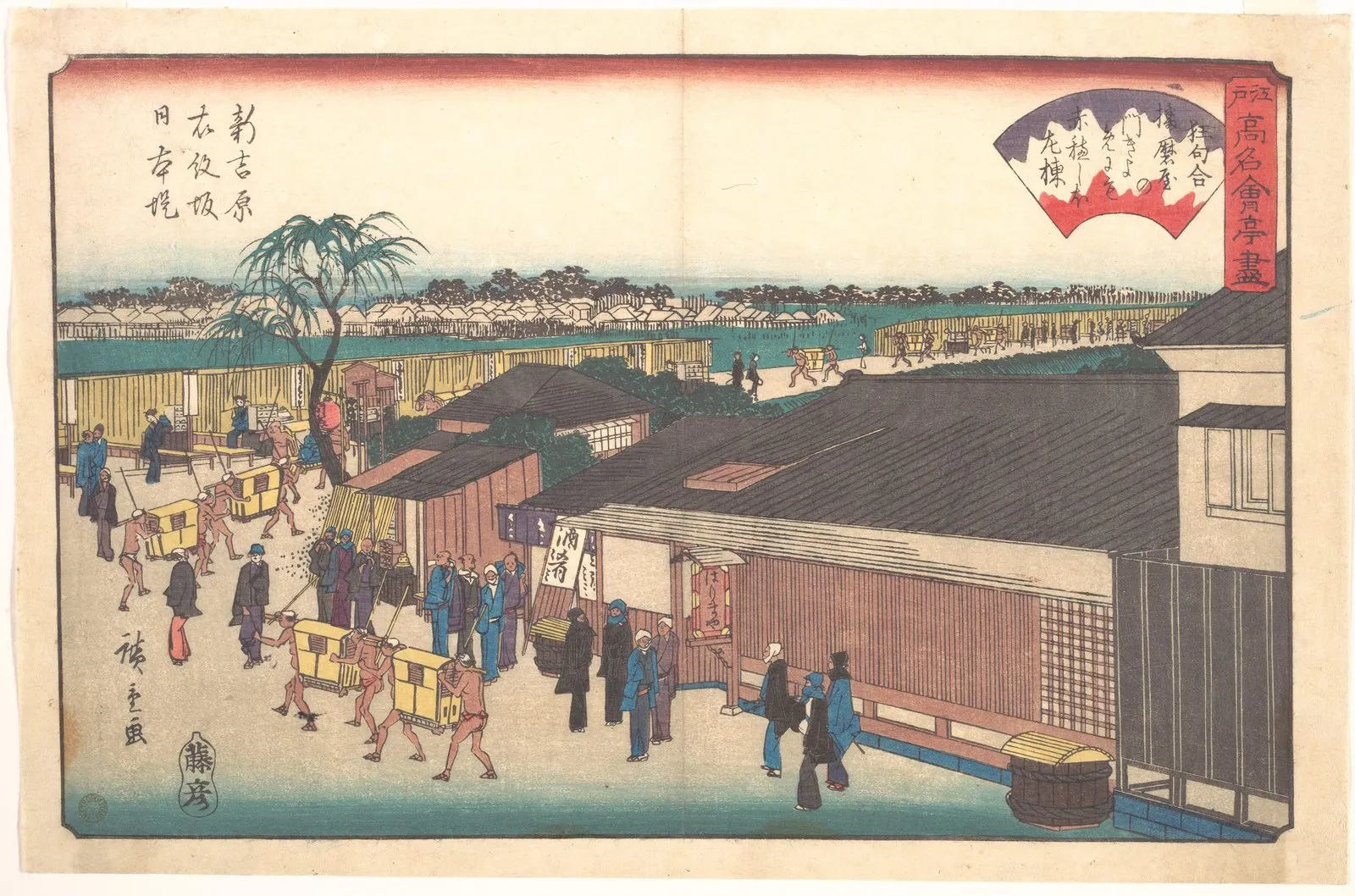
Utagawa Hiroshige, “The Harimaya at Shinyoshiwara Emonzaka Nihonzutsumi,” from the series Edo Kōmei Kaitei Zukushi, ca. 1835–42 / The Metropolitan Museum of Art, Open Access (CC0) accession JP1167 (objectID 45315). People walk along the embankment at the back, and the slope comes down toward us. A willow at left, a palanquin arriving, and at right the teahouse “Harimaya.”
So named because most visitors to the Yoshiwara set their dress to rights around here. — Yoshiwara Enkakushi, p. 38
There is a more concrete account. Shin-Yoshiwara Han’ei Sōshi, as quoted in Edo Kagai Enkakushi (1894), describes what visitors did at the teahouses just ahead. (Edo Kagai Enkakushi dates it to Enpō 6 (1678), but the copy of Shin-Yoshiwara Han’ei Sōshi held by the National Diet Library was published in the Kansei era (1789–1801), so the date has not been confirmed.)
The teahouses here set out tubs of water for visitors to rinse the mud from their feet, and so the place was called Doro-machi, “Mud Town.” At these teahouses one washed hands and feet, smoothed one’s sidelocks, and borrowed a braided sedge hat. — quoted in Edo Kagai Enkakushi, p. 120 (1894)
Wash your feet, smooth your hair, borrow a hat. That is what “setting your dress to rights” actually meant.
The Gojikken-michi: three bends
At the bottom of the slope begins the road to the Ōmon, the great gate. It is called the Gojikken-michi.
Walking it, the bend is less than I had expected: a long, gentle curve. I tried to catch it in a photograph, and as I took it I was thinking: will this get it across?
Still, walking it tells you something. You cannot go straight in to Naka-no-chō. And from Dote-dōri, you cannot see what lies ahead. The layout that the saiken — a guidebook to the Yoshiwara — described as “not revealing the quarter” is something you can feel in your own body.
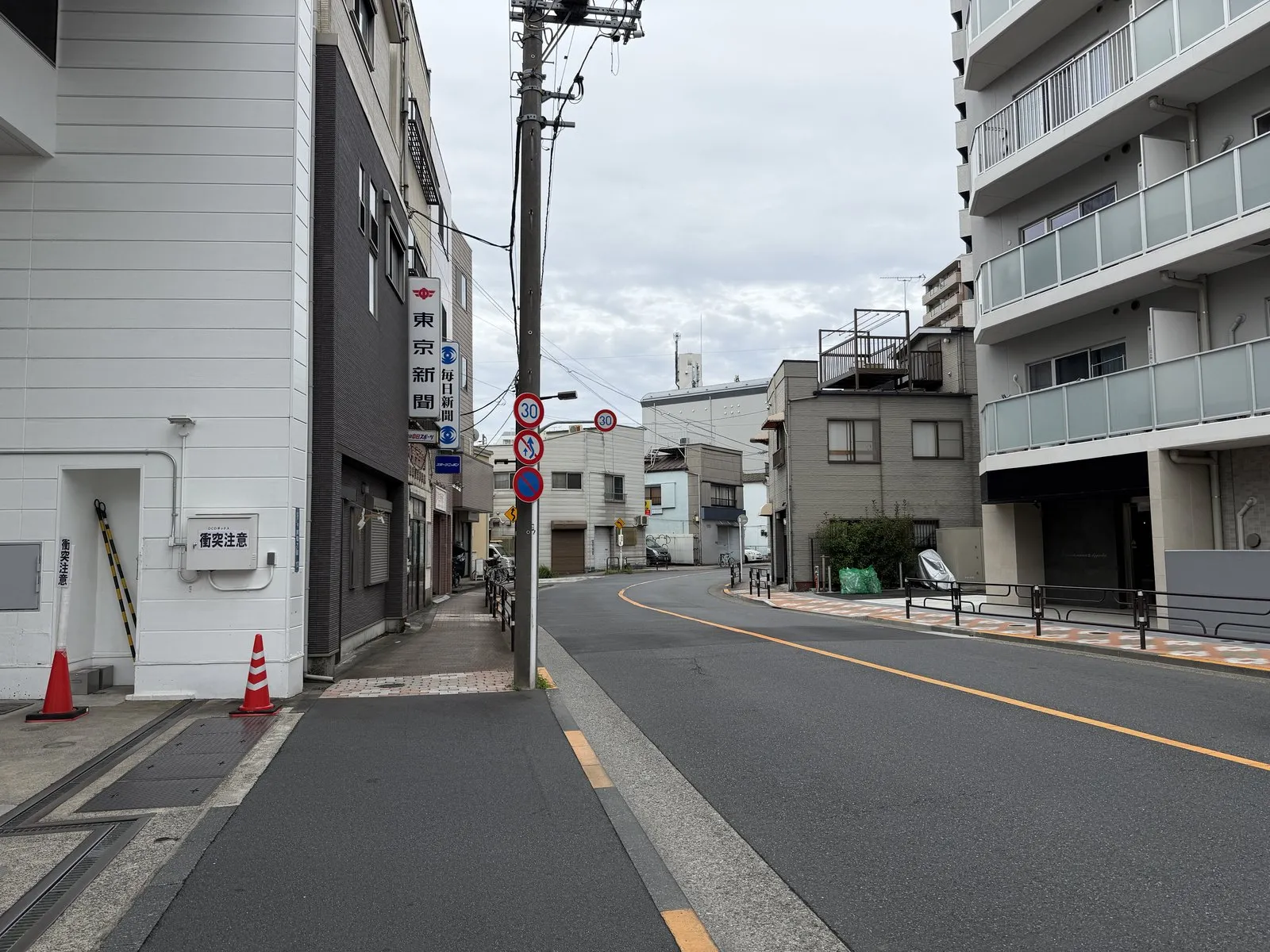
Looking toward the gate from the foot of the Mikaeri-yanagi (photographed August 11, 2026). The road bends gently to the right, and you cannot see ahead.
The old sources say this road was built with 三曲 — three bends.
The road from the great gate to the embankment was at first laid out straight, but by order of Lord Kan’o Bizen-no-kami it was rebuilt with three bends (三曲り). It is now called the Gojikken-michi. — Zōho Dōbō Goen, p. 376 (the Dōbō Goen was completed in Kyōhō 5 (1720) by Shōji Katsutomi, a descendant of Shōji Jin’emon, who founded the Yoshiwara; what I read is its expanded edition)
Kan’o Bizen-no-kami was one of the town magistrates who oversaw the move to Shin-Yoshiwara. Together with Ishigai Shōgen, he was the one who approved the terms of the move (Yoshiwara Enkakushi, p. 32).
Why bend it?
This is where it gets interesting. The later the source, the more it has to say about why.
| Source | Date | What it says about the reason |
|---|---|---|
| Zōho Dōbō Goen | Expanded edition of a work completed in Kyōhō 5 (1720) | Nothing. Just the fact |
| Yoshiwara Saiken Goyō no Matsu | Tenmei 3 (1783) | “It bends three times, and does not reveal the quarter” (lettered inside the road in its picture of the gate) |
| Hyōka Manpitsu | Late Edo period | The manservant Koheiji: a straight road “would leave nothing to wonder about” — plus the author’s own reasoning |
For a long time, this phrase could only be read in quotation. Hyōka Manpitsu and Yoshiwara Enkakushi both simply say “so it is written in the Yoshiwara saiken,” without showing the saiken itself.
But the saiken of Tenmei 3 (1783) includes a picture of the approach to the gate. A winding road is drawn, and inside the road itself, words are carved into the block: “This is the road called the Gojikken-michi, a street lined with houses; it bends three times and does not reveal the quarter.” I will show the picture later.
The quotations and the print itself differ in wording in places. But the name for the bends is written with the same two characters, 三曲, that the Dōbō Goen used when it wrote that the road was “rebuilt with three bends (三曲り).”
After Koheiji’s story, the author of Hyōka Manpitsu added his own reasoning (p. 265):
A book called the Sesetsu says that when a castle is built, its streets are laid out winding. This is so that the castle cannot easily be seen through in plain view.
It is the same logic as laying out a castle. Bend the streets below a castle on purpose, so that no one can see through to its heart — and apply that to the road into the Yoshiwara.
But this is the author’s reasoning, not something Koheiji said. The author himself notes that Koheiji, being a manservant, can hardly have said it from having read the Sesetsu.
Who had it bent also depends on the book. The oldest layer — the Dōbō Goen line, the Yoshiwara’s own records — names Kan’o Bizen-no-kami, and Koheiji does not appear — at least not in anything I have checked. The Koheiji story is one passed down in later essays, and the Meiji-era Yoshiwara Enkakushi dismisses it as “probably mere hearsay, not worth believing” (pp. 40–41).
Fifty ken — 間 or 軒?
The name’s origin is split, too. One theory says it is a distance; another, that it counts teahouses. And the spelling wavers: 五十間道, 五拾軒路, 五十軒道 — all read Gojikken-michi. The difference lies in the ken: 間 is a unit of length, 軒 a counter for buildings. The sound cannot tell you which. Sometimes the spelling wavers within a single book.
Out of those teahouses came a publisher: Tsutaya Jūzaburō. Born in the Yoshiwara, as a young man he started a book-lending business under the eaves of Tsutaya Jirobei’s teahouse on the Gojikken-michi, and later opened his own bookshop, the Kōshodō (Taitō ward signboard). The Yoshiwara Saiken Goyō no Matsu of Tenmei 3 (1783) that this article uses was published by Tsutajū — as he is known — himself. A teahouse on a bent road raised the publisher of the saiken.
What’s more, the frames on either side of that picture of the gate are packed with the names of teahouses and shops. Among them: “Saiken publisher, bookseller Tsutaya Jūzaburō.” The publisher printed his own shop into the picture of this road.
The Ōmon: a man once climbed onto its roof
Walk the bent road to its end, and you reach the Ōmon. This was the way in and out of the quarter.
It was a crossbeam gate lacquered deep black, its iron nails gleaming. It opened before dawn and was shut at night at yotsu (ten o’clock); after that, people passed through the side door. — Edo Kagai Enkakushi, p. 33
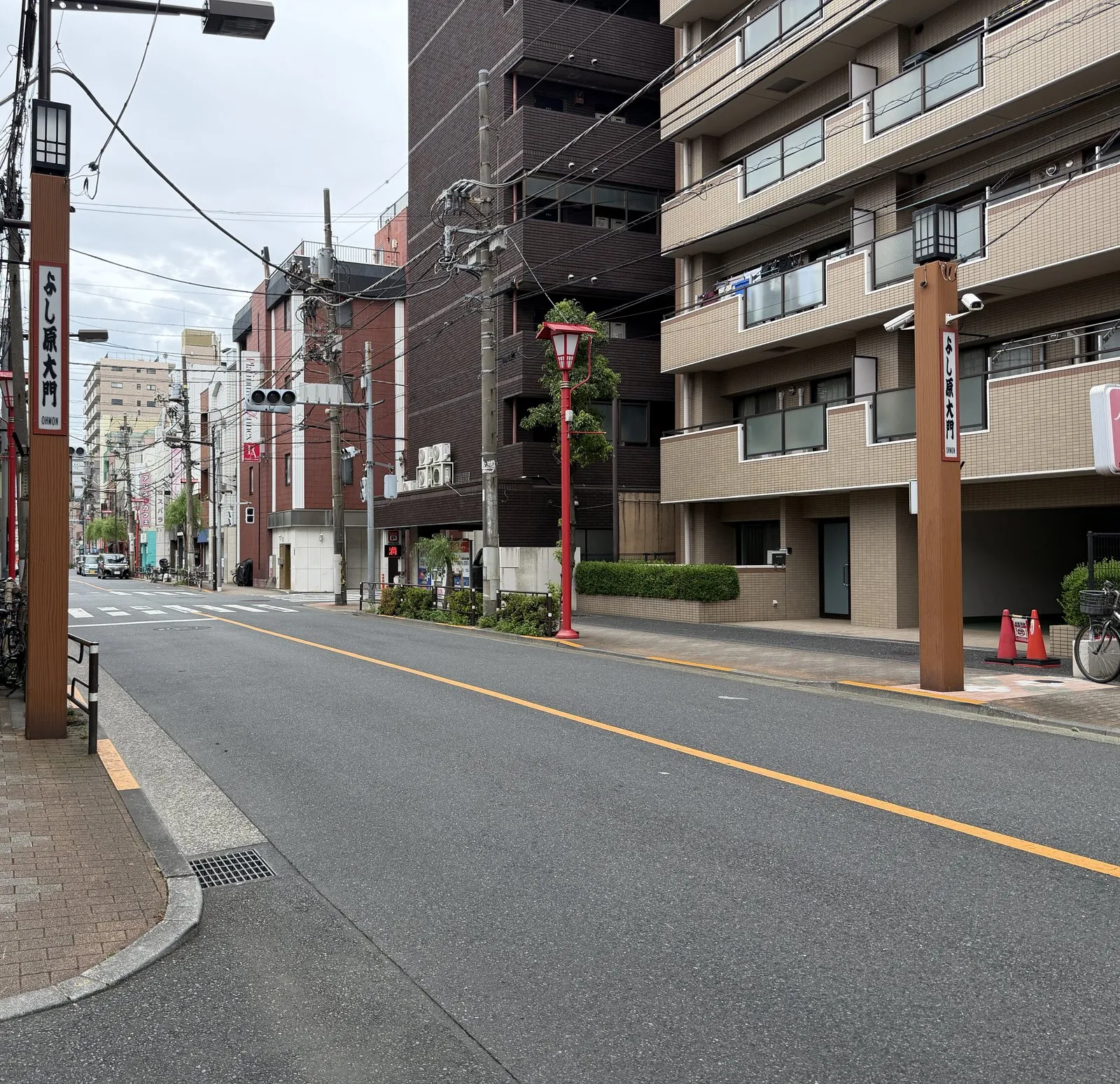
Past the Gojikken-michi, where pillars marked “Yoshiwara Ōmon” now stand on both sides of the road (photographed August 11, 2026). The gate itself does not survive.
A gate that closed at 10 p.m. Exactly where the Edo-period gate stood, I have not yet been able to confirm. The name survives in the crossing called Yoshiwara-ōmon, but that does not mean the gate stood there.
The headband came from the top of this gate
The picture on this site’s front page is Torii Kiyonaga’s Ichikawa Yaozō III as Sukeroku, from Tenmei 4 (1784). Sukeroku stands under a snake-eye umbrella amid falling cherry blossom, wearing a headband.
Where that headband came from is written down in Hyōka Manpitsu, a late-Edo essay collection (p. 296):
In a play called Keisei Hanakawado there is a jōruri piece, Sukeroku Ame no Michiyuki. The purple silk-crepe headband that a certain person suggested for it is how this Yume no Ichirobei looked in his brawl.
Yume no Ichirobei is said to have been the man who, when a great brawl broke out in the Yoshiwara, tied on a purple silk-crepe headband, climbed onto the roof of the Ōmon, called out his name at the top of his voice, and put an end to the fight. The same essay says, “This is still set down in the quarter’s old records.”
Sukeroku’s headband came down from the top of this gate — or so the people of Edo believed.
Incidentally, the year before this print was made — Tenmei 3 (1783) — the Yoshiwara Saiken Goyō no Matsu included a picture of the approach to the gate. It shows the whole sequence, from the Nihon-zutsumi down the Emon-zaka and along the Gojikken-michi to the Ōmon: the road this article has walked, drawn as a picture.
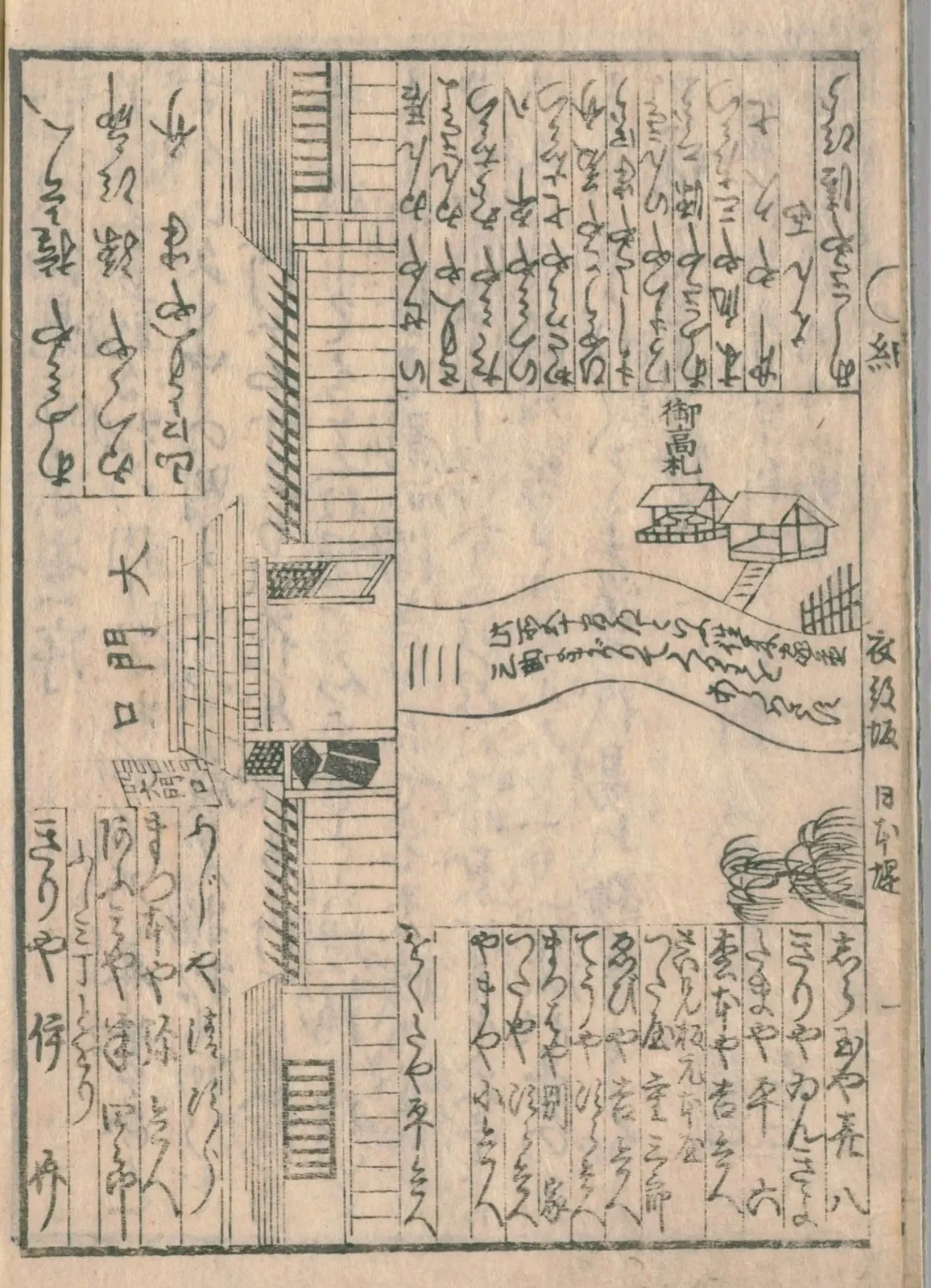
Yoshiwara Saiken Goyō no Matsu (published by Tsutaya Jūzaburō, Tenmei 3 (1783)), the picture at the front of the book. Reproduced from the National Diet Library Digital Collections (out of copyright) dl.ndl.go.jp/pid/2537563, frame 3. At the right edge, “Emon-zaka” and “Nihon-zutsumi”; lower right, a willow; top center, the official notice board; at left, “Ōmon-guchi.” The road is drawn winding, and inside it is carved: “This is the road called the Gojikken-michi, a street lined with houses; it bends three times and does not reveal the quarter.”
Beyond it, Sukeroku’s stage
The street running straight in from the Ōmon is Naka-no-chō (today’s Naka-no-chō-dōri). Sukeroku makes his entrance in front of the lattice of the Miuraya, a house facing onto Naka-no-chō (Kabukiza theatre program, March 2017).
The Miuraya really existed. What’s more, Miuraya Shirozaemon succeeded Shōji Jin’emon as sōnanushi, the headman of the whole quarter, and the name “Shirobei,” borne by the keeper of the guardhouse at the Ōmon, is said to come from a man employed by this same Miuraya (Edo Kagai Enkakushi, p. 34).
While we are at it: this town, too, moved here under orders — the very move that Kan’o Bizen-no-kami and his colleagues oversaw. So the road and the gate were both designed after the fact. The same thing happened to the theatres (→ Where Did Edo’s Three Theatres Go?, in Japanese).
So who was Sukeroku?
Here we leave the road for a moment. On the Asakusa side, in Hanakawado Park, stands the Sukeroku Ballad Monument. According to the Taitō Ward Board of Education signboard, the stone bears a poem composed and written out by Ichikawa Danjūrō IX himself, and it was erected in Meiji 12 (1879). The same signboard says that who the real Sukeroku was is unknown.
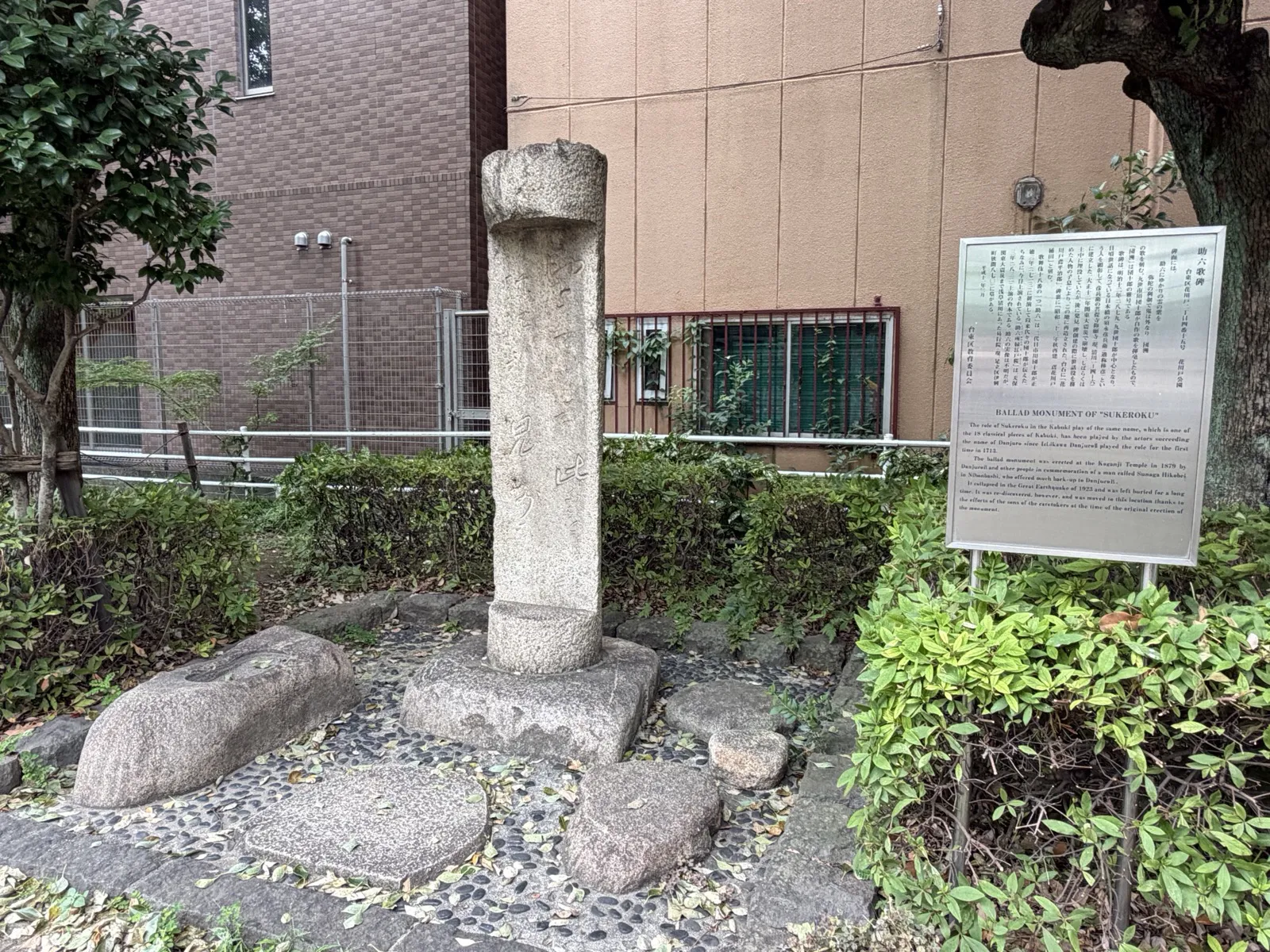
The Sukeroku Ballad Monument (Hanakawado 2-4-15, Taitō ward, in Hanakawado Park; photographed August 11, 2026). It is about 1.2 km south of the road we have been walking — not somewhere you pass on the way back from the Yoshiwara, but a detour from Asakusa. If you walk this route, it is better to start here. Directions are at the end of this article.
Edo had already answered that question — earlier, and in detail.
The play premiered in Shōtoku 3 (1713) at the Yamamuraza, a theatre abolished the following year over the Ejima-Ikushima affair, and long gone (→ Where Did Edo’s Three Theatres Go?, in Japanese). The Dōbō Goen, the Yoshiwara side’s own record, was completed in Kyōhō 5 (1720) — seven years after the premiere. Its expanded edition lists four “true stories” of Sukeroku (whether this passage is in the original or was added in the expansion, I have not yet confirmed):
- A man from around Asakusa with the haiku name Gyōu, commonly called Sukeroku, who frequented a courtesan named Agemaki
- Another version: Gyōu’s favorite was Matsugae, a courtesan of the Miuraya
- Sukeroku of Hanakawado in Asakusa — a swaggering otokodate (a self-styled champion of the townspeople), but a bad lot, who was later punished
- Yorozuya Sukeroku of Kyoto, who died in a lovers’ suicide with Agemaki, a courtesan of the Shimabara quarter
And it concludes:
It appears that these matters were mixed together to make up what is called the Sukeroku play. — Zōho Dōbō Goen, p. 400
It is not that the real Sukeroku is unknown. There were several real stories, and the play mixed them together — so wrote the Yoshiwara side, back in Edo.
The late-Edo Hyōka Manpitsu, too, writes: “There are all sorts of accounts of the true story of Sukeroku of Hanakawado, but I have seen none that is firmly settled” (p. 297). The name of the man said to be Sukeroku, however, differs from book to book (Zōho Dōbō Goen: Gyōu from around Asakusa; Hyōka Manpitsu: Ōguchiya Sukehachi of Yama-no-shuku).
Same play — different titles, different music
Sukeroku changes its title, and the music for the hero’s entrance, depending on who plays the role. The official sources say so themselves.
The narrative music played when Sukeroku enters is called kato-bushi, and is only used when an Ichikawa Danjuro family actor plays Sukeroku. (National Theatre, Invitation to Kabuki)
The title is changed from that of the Ichikawa family’s Sukeroku, and for the entrance, nagauta is used instead of Katō-bushi or Kiyomoto. (Shōchiku, Kabuki Bito)
When the Ichikawa Danjūrō family performs it, as part of the family’s own repertoire, the title is fixed as Sukeroku Yukari no Edozakura and the entrance music as Katō-bushi.
Anyone else changes both the title and the music. But it turned out not to be decided by family.
| Title | Entrance music | |
|---|---|---|
| Ichikawa Danjūrō family (family repertoire) | Sukeroku Yukari no Edozakura | Katō-bushi |
| The Otowaya style | Sukeroku Kuruwa no Momoyogusa | Kiyomoto |
| The Matsushimaya (Nizaemon) style | Sukeroku Kuruwa no Hatsu Zakura | Nagauta |
Otowaya and Matsushimaya are yagō, the house names of acting lines. Katō-bushi and Kiyomoto are two schools of narrative jōruri music; nagauta is the long-song style of the kabuki orchestra.
It changes even within one family. Nakamura Kankurō’s grandfather played it in the Otowaya style, with Kiyomoto; Kankurō is following Kataoka Nizaemon and will use nagauta (press conference announcing the production, July 2026). His father, Kanzaburō XVIII, died without ever playing Sukeroku. What decides it is whose style you inherit.
Then again, neither Katō-bushi nor this title belonged to the Danjūrō family at first. Katō-bushi was first attached to Sukeroku in Kyōhō 18 (1733), in Hanabusa Bunshin Soga, with Ichimura Takenojō in the role (Nihon Daihyakka Zensho encyclopedia). The title Sukeroku Yukari no Edozakura began as the name of a Katō-bushi piece, performed in the third month of Hōreki 11 (1761) when Ichimura Kamezō I played the role (Sekai Daihyakka Jiten encyclopedia). Both were actors of the Ichimura family, not Danjūrō. So the title and music becoming the Danjūrō family’s alone must be a later custom. When it became fixed, I have not yet confirmed.
Of the three styles, I have seen two.
I saw Ichikawa Ebizō — of the Danjūrō family, and now Danjūrō XIII — as Sukeroku in March 2017. His tsurane, the self-introduction speech, and the scene where he picks a fight with the villain Ikyū both look like things he might well do at a drinking party anyway, and that is what makes them fun. It felt as if he had carried his own mischievous energy straight onto the stage: this was Sukeroku through and through, a Sukeroku only Ebizō could do. He has the looks, too, which makes him perfect for a dashing Sukeroku.
The following year, in October 2018, I saw Nizaemon’s Sukeroku as well. I had high hopes, but Ebizō had been Sukeroku to the life, and I realized that I do prefer a Sukeroku bursting with youth.
And in October 2026, Kankurō plays the role for the first time. I am looking forward to it. But I also worry that he may come across as too refined. There should still be some youth left in him, so I hope he plays it with plenty of mischief.
Having walked it
I turned in at the Ōmon crossing and rode my bicycle all the way through Naka-no-chō to the far end. Ten in the morning. Few people about, and quiet. A parent was out walking with a child, and it struck me that people live here, too.
From Dote-dōri, you cannot see where this road leads. It was built that way on purpose. And yet the road connects. Just past the bend off Dote-dōri — the road I had taken so many times — was the stage of Sukeroku.
History joins up. It’s that feeling I love.
A word to anyone walking it. Once you pass from the Gojikken-michi into Naka-no-chō, you are in a neighborhood where people still live and shops are open for business. I was there at ten in the morning; at other hours, the place shows a different face. If you take photographs, keep people and shops out of them. The photographs in this article were chosen that way too.
Getting there
This section exists only in the English edition (see STRATEGY §8.5: practical information for visitors).
- Start in Asakusa. The Sukeroku Ballad Monument is at the back of Hanakawado Park, a five-minute walk from Asakusa Station (Tobu, Tokyo Metro, Toei). Another monument, for the Ubagaike pond, stands in the same corner — look for the stone pillar with a poem carved on it.
- From there, the walk in the route box below goes the way Edo’s visitors went: north up the line of the Nihon-zutsumi, then down into the bent road. It is about 1.9 km, just under half an hour on foot, with a short detour through old Saruwakachō, where the monuments to Edo’s theatres stand.
- From the Yoshiwara end, the nearest station is Minowa (Tokyo Metro Hibiya Line): about 12 minutes on foot to the pillars marking the site of the Ōmon, and about 15 to the Mikaeri-yanagi, which stands by the Yoshiwara-ōmon crossing on Dote-dōri. The crossing and the pillars are about 120 meters apart in a straight line; the Emon-zaka and the Gojikken-michi lie between them. The walk ends at Yoshiwara Shrine, and both Minowa and Asakusa stations are within walking distance from there.
- What you will find is mostly names. The Ōmon survives only as a crossing name and a pair of pillars; the gate is gone, and exactly where it stood is not confirmed. The Mikaeri-yanagi is neither the original tree nor in the original spot. Of the Nihon-zutsumi embankment, none of its height is left — Dote-dōri simply follows its line. This article is the context that makes them worth standing in front of.
- Beyond Naka-no-chō is a neighborhood where people live and work. Please read “A word to anyone walking it” above before you go.
- In October 2026, Nakamura Kankurō plays Sukeroku (Sukeroku Kuruwa no Hatsu Zakura) at the Heisei Nakamuraza, the temporary theatre in the grounds of Sensō-ji in Asakusa (October 1–25). The theatre gives two programs a day, and Sukeroku is in Part 2, which starts at 4 p.m.; Part 1 does not include it. The walk starts on the same side of town, so you can do it before or after the play. If the Japanese ticket site shows the run as sold out, Shochiku’s official English-language site, Shochiku Multilingual Online Ticket, sometimes has seats of its own.
Sources (6)
The sources are those of the Japanese original, which this article was translated from; see the Japanese edition for the full list: Yoshiwara Enkakushi (1891), Edo Kagai Enkakushi (1894), and Zōho Dōbō Goen and Hyōka Manpitsu (in the 1927 Zuihitsu Bungaku Senshū series), all via the National Diet Library Digital Collections and out of copyright; the Yoshiwara Saiken Goyō no Matsu of 1783 (NDL, out of copyright); the Hiroshige and Kiyonaga prints at The Metropolitan Museum of Art (Open Access, CC0); Taitō ward signboards, photographed and transcribed on site on August 11, 2026; the Kabukiza theatre program of March 2017 (kabukidb 721) and the October 2018 performance (kabukidb 741); the National Theatre’s Invitation to Kabuki and Shōchiku’s Kabuki Bito; a SPICE report on the production press conference of July 28, 2026; and the encyclopedias collected on Kotobank.
Translation notes (differences from the Japanese original, per research/eigo-yakugo.md):
- Two passages show kanji inline, because romanization erases the point: the name of the Gojikken-michi, where 間 (a unit of length) and 軒 (a counter for buildings) are both read ken; and the word 三曲, where the argument rests on two books using the same characters. Elsewhere, where the Japanese compares wording (廓/くるわ), this edition says only that the wording differs.
- The quotations from Edo- and Meiji-period books are this site’s own translations. The sentence on Katō-bushi is quoted from the National Theatre’s English site as written.
- Ebizō is identified as a member of the Danjūrō family and as today’s Danjūrō XIII (he took the name in 2022). The Japanese edition does not need to say so; without it, the “two of the three styles” would not add up for readers outside Japan.
- Era years are given with their Western year. Lunisolar months before 1873 are written as “the third month,” not as March.
- Book titles are romanized according to the readings in the National Diet Library catalog.
- The theatre program was used to confirm names and facts only; its English synopsis was not consulted for wording.