Counting the monuments
In Asakusa 6-chōme, three stone monuments stand.
From south to north: the Saruwakachō monument (Asakusa 6-19), the monument to the site of the Ichimuraza of Edo’s Saruwakachō (Asakusa 6-18), and the monument to the site of the Moritaza of Edo’s Saruwakachō (Asakusa 6-26). Taitō ward’s signboard on the origin of the old town name lists exactly these three — and nothing else — as the landmarks of the former Asakusa Saruwakachō.
Saruwakachō was the theatre district where the three licensed theatres of Edo — the Nakamuraza, the Ichimuraza, and the Kawarasakiza (later the Moritaza) — were gathered together. The Nakamuraza stood in 1-chōme, the first block of the town; the Ichimuraza in 2-chōme; the Kawarasakiza in 3-chōme. If you were putting up monuments, you would naturally expect one for each of the three.
But count them, and there is a monument to the Ichimuraza and one to the Moritaza — and none to the Nakamuraza.
Maybe it is simply missing from the ward’s list and stands somewhere nearby. I thought so too, and went looking. The ward’s list gives a street address for each landmark, so it can be checked. The ward’s three are all there is, and along the street I found no other monument. Only the Nakamuraza — the theatre of 1-chōme — has no monument in Saruwakachō.
Incidentally, there is a reason the Nakamuraza was given 1-chōme. It was ranked first among the three theatres, according to the program for the February 2017 performances at the Kabukiza. The theatre that got the first block for being first is the one without a monument today.
All three monuments face the street and can be read from the road without entering anyone’s property (the Saruwakachō monument stands at the back of a parking lot, but you can see it from the street). Around them is an entirely ordinary residential neighborhood — apartment blocks and old-style row houses. Apart from the monuments, almost nothing tells you this was once a theatre district.
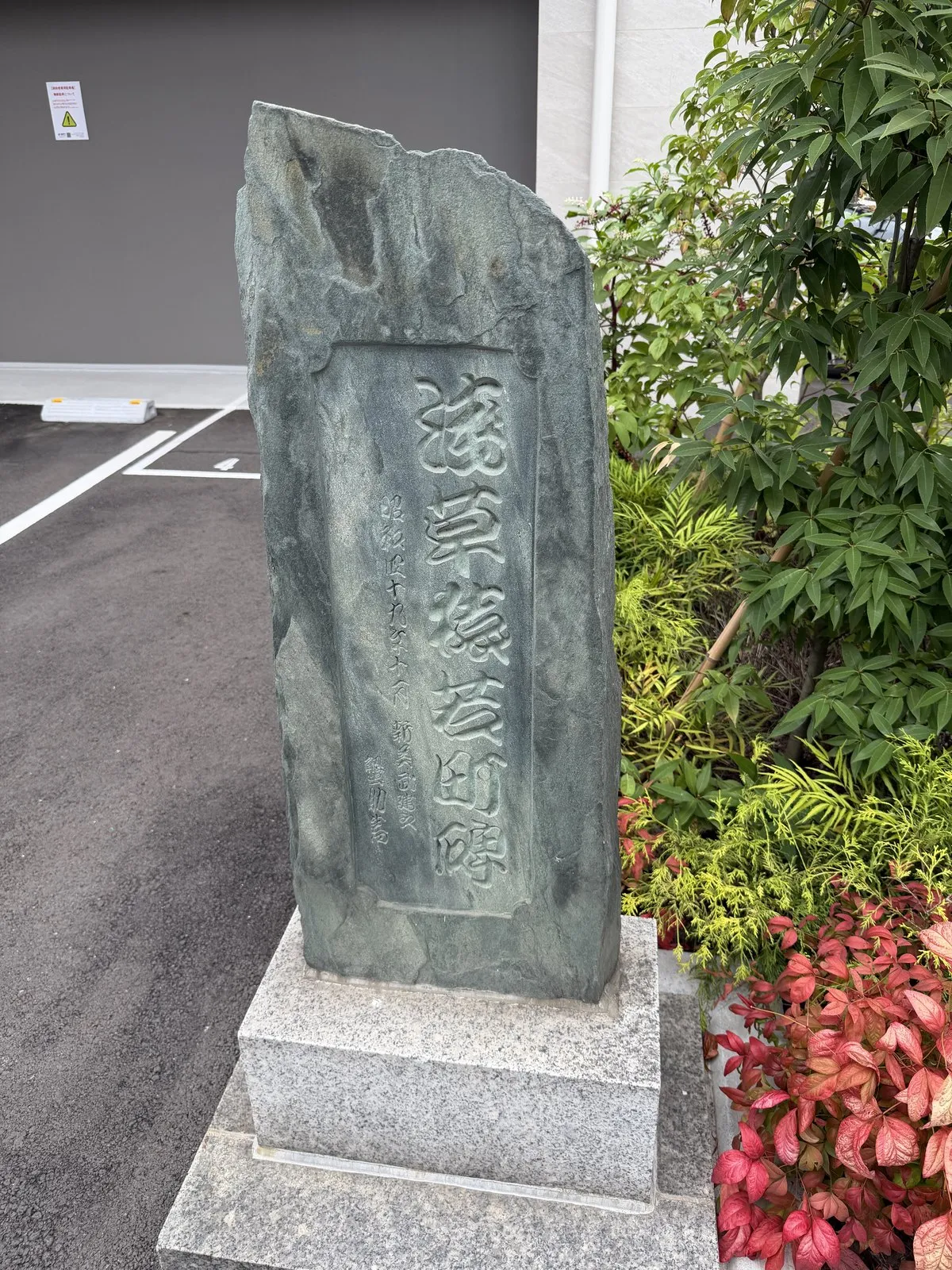
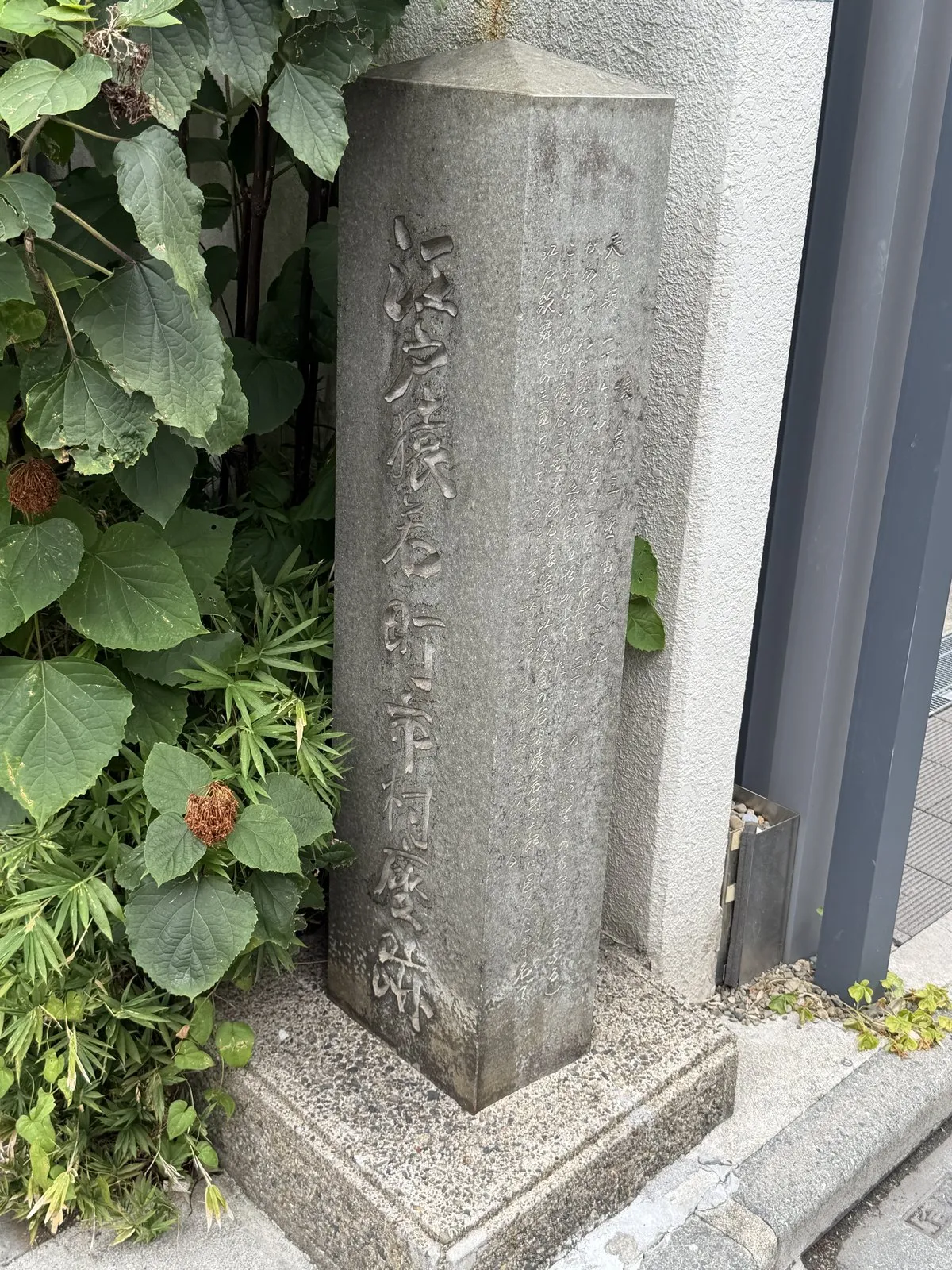
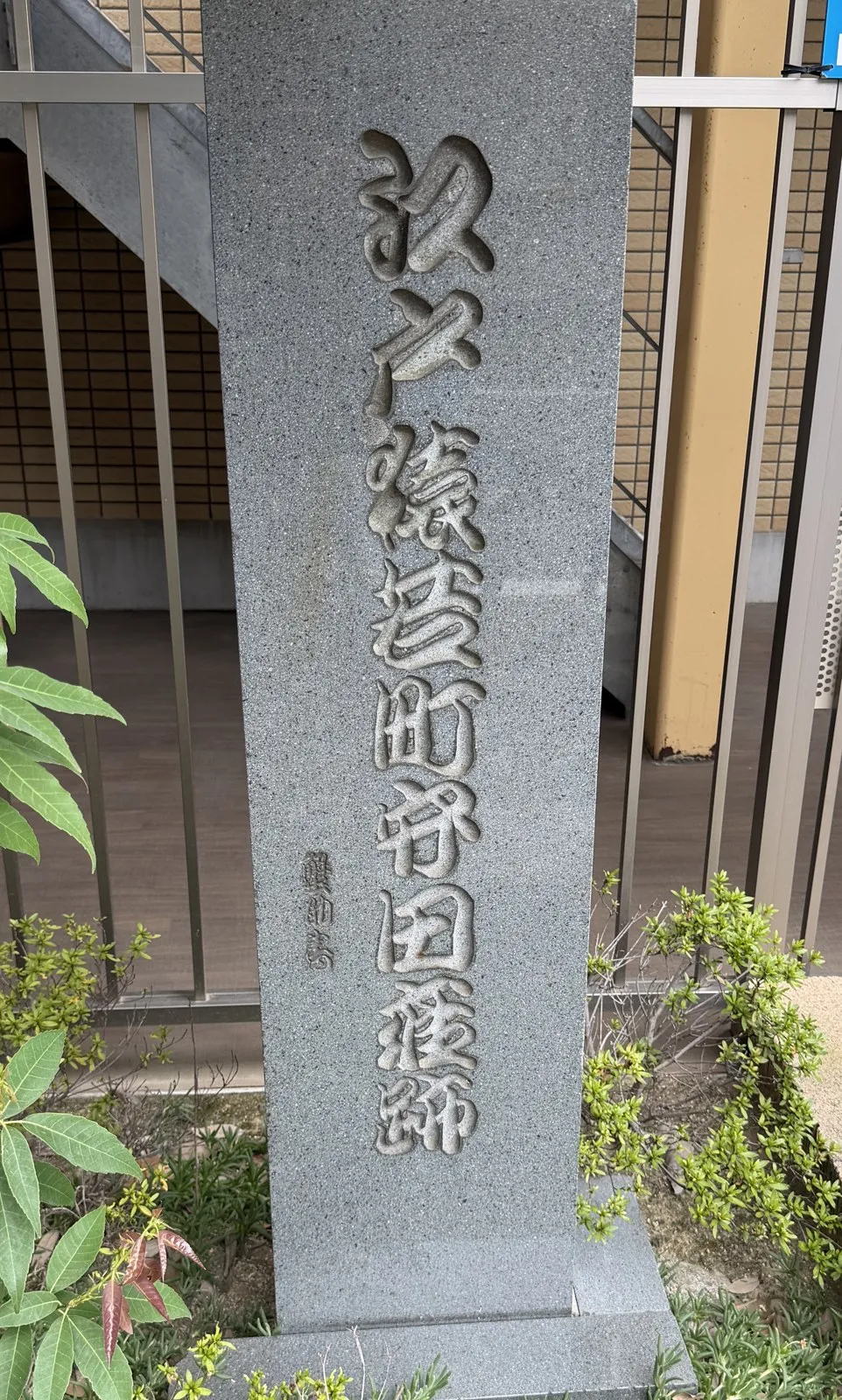
All three photographed August 11, 2026. From top to bottom, south to north; they stand within about 115 meters of one another. All three face the street and can be read without entering the grounds.
This article chases that absence. I will say up front that I do not have the answer yet. But along the way, I found out a good many other things.
Why “three” in the first place?
Before that, there is one thing I want to check. Why three?
The theatres of Edo were not three to begin with. After the Nakamuraza — the theatre that would later settle in Sakaichō — the Ichimuraza of Fukiyachō, and the Moritaza and the Yamamuraza of Kobikichō, were each licensed to raise a yagura (the drum tower that marked a licensed theatre). By the Genroku era, around 1700, there were four. The Yamamuraza stood in Kobikichō, the same town as the Moritaza. (Its block number differs between sources: Nihon Engekishi gives 5-chōme, Engeki Taizen 6-chōme.)
Four became three because of an incident in Shōtoku 4 (1714). Ejima, a senior official of the Ōoku — the shogun’s inner quarters — was found to have been stopping at the Yamamuraza on her way back from a temple visit she made on the shogunal household’s behalf. Ejima was banished to Takatō in Shinano province; the actor Ikushima Shingorō and the theatre’s zamoto (the licensed theatre proprietor), Yamamura Chōdayū, were exiled to islands. And the Yamamuraza was abolished, its name struck out.
And the Yamamuraza was not the only theatre punished. Tōto Gekijō Enkakushi excerpts a diary from the time when Nakamura Kanzaburō VI was proprietor of the Nakamuraza. According to it, the remaining three theatres were also ordered to stop performing, and told to suspend theatre altogether. They were allowed to reopen after about a month — but in exchange, their gallery seating was cut down. “Upper and lower crushed, one middle row left” — seating that had been three tiers high was reduced to one. Permission to restore it, granted on petition, came only eleven years later.
So the name “the three theatres of Edo” was not a frame that existed from the start. It is the number that was left after one theatre was erased and the rest were cut back.
Incidentally, the sources do not agree on the details of this incident.
| Month of the incident | Where the proprietor Yamamura Chōdayū was exiled | |
|---|---|---|
| Kabukiza program, February 2017 | 1st month | (Ikushima: Miyakejima) |
| Engeki Taizen (1906) | 5th month | Hachijōjima |
| Tōto Gekijō Enkakushi (1917) | 2nd month | Ōshima, in Izu |
Three sources, three answers — so this article commits to neither the month nor the place of exile. All three agree that the theatre’s name was struck out and that the other three theatres were punished as well, so that is as far as I will go.
This is a story about one monument too few. But before we even get there, one theatre has already gone missing.
A town built by the evicted
First, how Saruwakachō came to be.
In Tenpō 12 (1841), as part of the Tenpō Reforms, the shogunate confiscated the shimo-yashiki (an outlying villa) of the Koide family, lords of the Sonobe domain in Tanba province. It then ordered the theatres of the city of Edo to move onto that site. The theatres moved in over Tenpō 13 and 14 (1842–43), and a town took shape. It was named after Saruwaka Kanzaburō (later Nakamura Kanzaburō I), said to be the founder of Edo kabuki.
Officially, the fire started in a teahouse
It started with a fire. At dawn on the 7th day of the tenth month of Tenpō 12, a fire broke out in the dressing rooms of the Nakamuraza in Sakaichō. An area a little over two chō across and about four chō deep — roughly 220 by 440 meters — burned at once. The Ichimuraza burned too, along with a puppet theatre and the towns of Horie-Rokkenchō, Moto-Ōsakachō, Shin-Izumichō, and Shin-Norimonochō.
(This date, too, differs from book to book. Engeki Taizen, p. 47, gives dawn on the 7th of the eleventh month, and puts the halt on rebuilding at “the 20th of the same month” — a month later in both cases. This article follows the dates in Shibai Sōshi.)
Here, one line caught my attention. Shibai Sōshi, part 4, “Tōto Gekijō Enkakushi” (by Sekine Shisei, published 1917), writes: “The origin of the fire was officially reported as the mizu-jaya (a simple teahouse) of Sakuraya Kiemon in Sakaichō.”
In other words, the fire was reported, for the record, as having started in a teahouse. In fact it started in the Nakamuraza’s dressing rooms. The book does not say what this statement is based on, so I will not go beyond “that is what it says.” Still, knowing what happened to the theatre district next, I imagine there was a reason to want it hidden.
And within half a year, a town stood
Line up the dates and you get this. On the 20th of the tenth month, rebuilding was halted. On the last day of the twelfth month — February 9, 1842, by the Gregorian calendar — the theatres were ordered to move. Repeated petitions for mercy went unheard, and on the 8th of the second month of the following year, Tenpō 13, they were granted the former Koide shimo-yashiki land at Yabunouchi in Asakusa. In the fourth month of that year they were given the town name “Saruwakachō.” The map handing over the lots is dated the 9th of the sixth month, and the actual move came in the seventh month.
As an allowance for the move, 5,500 ryō in gold was granted to Sakaichō and Fukiyachō.
And this land had originally been a marsh. It was the place popularly called Ubagaike, “the old woman’s pond,” and it is described as “very low-lying ground.” So how was it filled in?
They were given earth from a sandbar in the Sumida River, and the teahouses and dekata (theatre attendants) of the two towns carried the soil, more than a hundred people a day. They filled the ground, cut down the mounds, dug out the tree roots — and in the fifth month of Tenpō 13, the work was done.
The evicted theatre district stands on ground built by the evicted themselves, one load of soil at a time.
Saruwakachō, in short, is where they were driven to. On the grounds that theatre corrupted public morals, the theatres were moved out of the heart of the city — Nihonbashi and Kyōbashi — to what was then the northern edge of Edo.
It was not only the three kabuki theatres that moved. According to the ward’s signboard, 1-chōme received the Nakamuraza and the Satsumaza, and 2-chōme the Ichimuraza and the Yūkiza — both of them puppet theatres (ningyō jōruri). A theatre district was not a kabuki-only town.
We even know the proprietors’ names. The puppet theatre in 1-chōme was run by Ōzatsuma Kichiemon, the one in 2-chōme by Yūki Magosaburō. The “Kichiemon puppet theatre” and “Magosaburō puppet theatre” marked on the lot map are these two men. The Yūkiza is said to survive today as a troupe of Edo string marionettes.
There is also a famous story about how this town came about. When Mizuno Tadakuni, who led the Tenpō Reforms, moved to abolish the theatres, Tōyama Saemon-no-jō Kagemoto — known to every viewer of Japanese period dramas as “Tōyama no Kin-san” — argued that taking entertainment away from ordinary people would do nothing to settle their minds; and so the theatres were moved to the outskirts instead of being abolished.
On site, the only thing that tells this story is a placard that appears to have been put up by the neighborhood association; the ward’s signboards do not mention it. So at first I had filed it under “legend.”
But there turned out to be a book that records it: Engeki Taizen, published in 1906 (by Sekine Mokuan). It has a whole chapter titled “The Move to Saruwakachō and Tōyama Saemon-no-jō,” which ends by saying that the unbroken growth and prosperity of theatre down to the present day is truly thanks to Tōyama.
What is more, the book reprints the memorandum Tōyama submitted to Mizuno, in full. “A memorandum setting out my considered views on the relocation of the theatres and related controls — Tōyama Saemon-no-jō,” dated the 10th of the twelfth month, Year of the Ox — that is, Tenpō 12. It opens with “the inquiry you sent down on the 2nd.” So the inquiry came down on the 2nd of the twelfth month, Tōyama answered on the 10th, and the replacement site was decided on the 18th — all three dates falling in January 1842 by the Gregorian calendar. He wrote his answer in eight days. (This “18th” is Engeki Taizen’s date, and it does not line up with the sequence I took from Shibai Sōshi above — the order to move on the last day of the twelfth month, the land on the 8th of the second month. The two books disagree here as well.)
This date, though, is different in another book. Shibai Sōshi (1917), which collects the writings of Sekine Shisei — the father of Engeki Taizen’s author — gives the same memorandum as “the 10th of the eleventh month,” and the inquiry as “the second month.” Father and son do not agree on the numbers, and I cannot decide which is right. Here I follow Engeki Taizen’s dates and note that the discrepancy exists.
The book also records another version. A man named Naruse Kichiemon, one of Mizuno’s private secretaries, secretly rushed word to Tōyama that the destruction of the theatres had been decided, and Tōyama at once drafted a reply in their defense — “so it is also said.” Whose credit it was, apparently, had not settled into a single story even by the Meiji era.
Engeki Taizen, however, does not cite its source either. The records that hold the original of the memorandum (the “Theatre Relocation” section of Shichū Torishimari Ruishū) are in the National Diet Library and out of copyright — but they are a manuscript copy in cursive script, which I cannot read yet. So this article goes no further than “a theatre history published in 1906 says so.”
As a town name, Saruwakachō lasted 124 years, until the new address system was introduced in October 1966.
Signboards from the same ward disagree
So where were the three theatres before the move? Here something odd happens. Within the same Taitō ward, the signboards give different answers.
- The Sanyabori Historical Tour signboard says the three theatres were in “Fukiyachō in the city of Edo.” Its English side says the same, putting all three together as “previously in Fukiyachō.”
- The old-town-name signboard names three towns: “Sakaichō, Fukiyachō, and Kobikichō.”
The standard account is Nakamuraza = Sakaichō, Ichimuraza = Fukiyachō, Moritaza = Kobikichō. I went looking for a third source, and found one. Engeki Taizen (1906) writes that they were “commonly called the Nakamuraza as 1-chōme, the Ichimuraza as 2-chōme, and the Moritaza as 3-chōme” (that the Moritaza began in Kobikichō is in the book’s entry on the Moritaza). And of the towns ordered to move, it writes: “the kabuki theatres and puppet theatres and others of Sakaichō and Fukiyachō … were moved to Asakusa Shōdenchō.” The old-town-name signboard is the correct one.
So is the Historical Tour signboard simply wrong? This is where something else turned up.
Engeki Taizen traces the Nakamuraza’s moves like this: Nakabashi → Negichō (later Sakaichō) in Kan’ei 9 (1632) → on to Sakaichō in Keian 4 (1651) — first Upper Sakaichō, later Lower Sakaichō. In other words, Sakaichō had an upper and a lower part.
Sakaichō and Fukiyachō were split by drawing lots
Ihara Seiseien’s Nihon Engekishi (1904) describes how this came about in detail. When I read it, it was a better story than I had expected.
In the fifth month of Keian 4 (1651), the theatres that had been in Negichō were moved, all together, to Sakaichō. Sakaichō at the time was divided into an upper and a lower town, and Upper Sakaichō already had the Murayamaza (later the Ichimuraza). When the Saruwakaza (later the Nakamuraza) moved in too, Upper Sakaichō grew busier still. Lower Sakaichō, meanwhile, had only puppet shows and small theatres, and was nowhere near as lively.
So the two towns talked it over and petitioned to place one major theatre in each, upper and lower. Permission was granted. And then —
having obtained official permission, they settled it by drawing lots
They drew lots. The Murayamaza stayed where it was, and the Saruwakaza moved to Lower Sakaichō.
In later years, Upper Sakaichō came to be called Fukiyachō, and Lower Sakaichō simply Sakaichō. The book goes on: the Yamamuraza was in Kobikichō 5-chōme, so these three towns — Sakaichō, Fukiyachō, and Kobikichō — were fixed as the locations of Edo’s theatres, and stayed almost unchanged for two hundred years, until the Tenpō era.
So the “Sakaichō” of the Nakamuraza and the “Fukiyachō” of the Ichimuraza were originally the upper and lower halves of a single Sakaichō. And the two theatres ended up in different towns because of a lottery.
One more thing turned up: where the Murayamaza, the Ichimuraza’s predecessor, began. The Taitō ward signboard and Engeki Taizen both say “Fukiyachō.” But Tōto Gekijō Enkakushi, quoting the statement of origins submitted by the proprietor Murayama Matasaburō, writes:
We petitioned to stage kabuki, and permission was first granted in Sakaichō
The Murayamaza began in Sakaichō. Since Upper Sakaichō later came to be called Fukiyachō, this is no contradiction. Write it back in time using the later name, and it becomes “Fukiyachō.”
If so, the Historical Tour signboard’s putting all three theatres in “Fukiyachō” may be less a mistake than old and new names mixed together. I will not assert it. But going back to the original sources turned up something more interesting than “which one is right.”
One more thing has been nagging at me: how the old-town-name signboard writes Sakaichō. The usual spelling is 堺町; the signboard writes 境町. Both are read the same way — Sakaichō — and only the first character differs. A slip on the ward’s part, I thought at first.
But Shōchiku’s theatre program writes 境町 too. The program for the February 2017 Saruwaka Festival at the Kabukiza says the Nakamuraza moved to Sakaichō, “likewise in Nihonbashi” (today’s Nihonbashi Ningyōchō 3-chōme) — and writes it 境町, the same as the ward’s signboard.
Meiji-era theatre histories, by contrast, consistently write 堺町. Which spelling is the original, or whether both were in use, I do not know yet. But I am glad I did not write it off as a mistake.
Even when the same ward puts them up, the signboards do not agree. “It says so on the signboard” is not evidence on its own — a lesson this site has run into more than once, but this time it was two signboards from the same ward contradicting each other. And going back to the original sources gave an answer in which neither side can simply be dismissed.
All three theatres within a one-minute walk
I worked out the distances between the monuments from the location data in the EXIF of the photos I took on site. (This is not a survey, so treat the numbers as rough.)
From the Saruwakachō monument to the Ichimuraza monument: about 61 meters. From the Ichimuraza monument to the Moritaza monument: about 55 meters. From the southern end to the northern end: about 115 meters. I walked it, and it really does fit within a minute.
(Add them up and you get 116 meters, one meter off — because the three do not stand in a perfectly straight line. This article is full of things like this.)
“1-chōme, 2-chōme, 3-chōme” sounds spread out, but the three theatres’ monuments fit within these 115 meters. How precisely the monuments mark where the theatres stood, I cannot say — but three theatre frontages of eleven ken (about 20 meters) each, from the lot map below, set side by side, come out at the same order of magnitude.
A lot map from the time survives. Engeki Taizen reproduces it: “Tenpō 13, Year of the Tiger, sixth month, 9th day / handover of lots / Saruwakachō, three blocks / map.” It shows the plots the shogunate gave the three theatres —
- Kanzaburō’s kabuki theatre (the Nakamuraza): 236-odd tsubo
- Uzaemon’s kabuki theatre (the Ichimuraza): 236-odd tsubo
- Gonnosuke’s kabuki theatre (the Kawarasakiza): 236-odd tsubo
All three are exactly the same size. 236 tsubo is about 780 square meters. The two puppet theatres were given a little over half that (127-odd tsubo). The street is marked “actual road width, five ken” — about 9 meters.
Here too the numbers split. The report submitted by Saruwakachō’s headman in Ansei 4 (1857) gives 236.5 tsubo; Shibai Sōshi gives 233.5 tsubo. But the report also gives the frontage and depth, and 11 ken × 21.5 ken = 236.5 tsubo. The arithmetic sides with 236. (For the puppet theatres, 127.75 tsubo matched in all three books.)
In other words, the new theatre district was designed with the three theatres side by side in a row, on plots of equal size. It was an eviction, but the land was divided evenly.
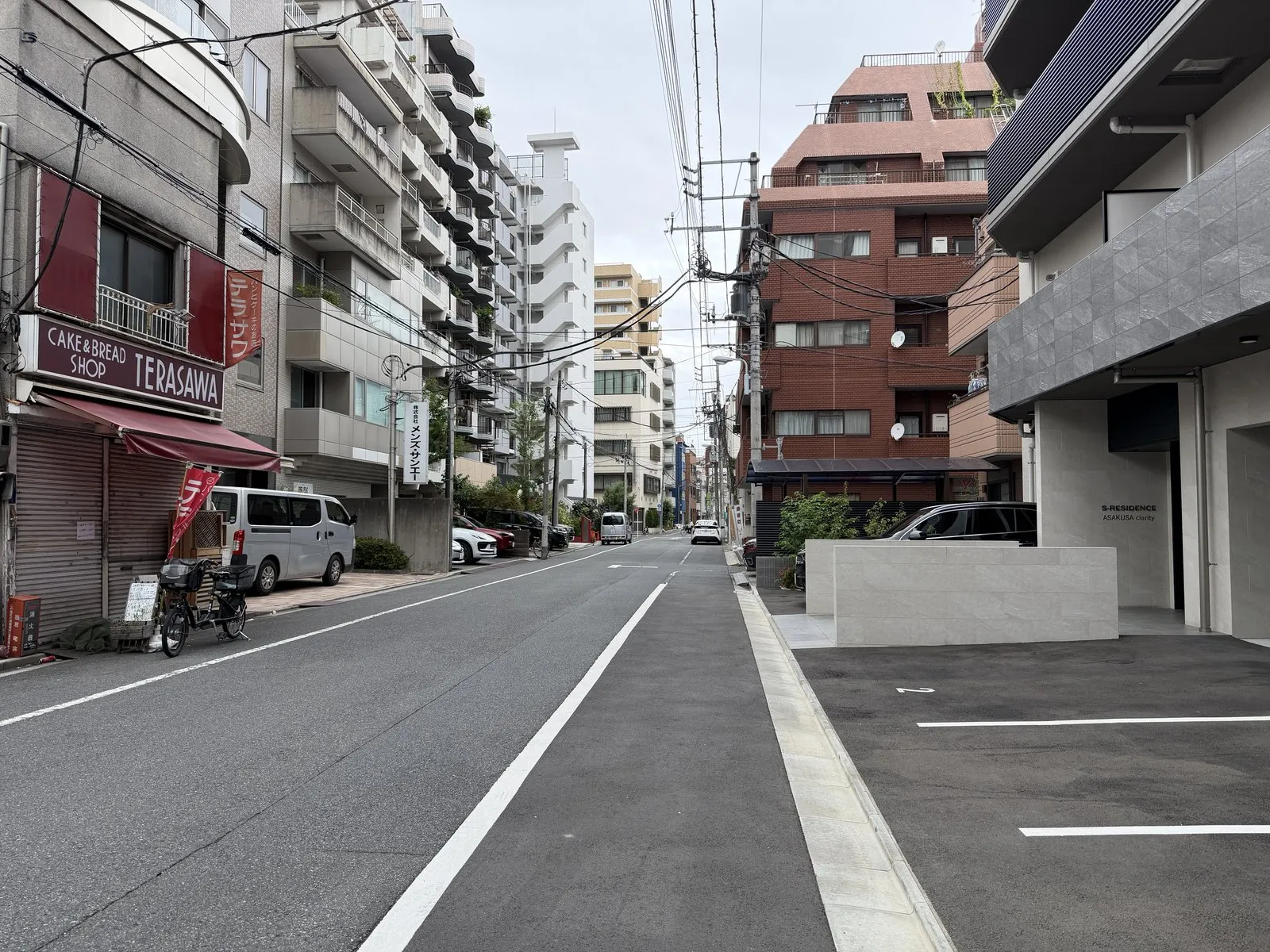
The street where the three theatres once stood in a row (photographed August 11, 2026). Today it is lined with houses and apartment blocks.
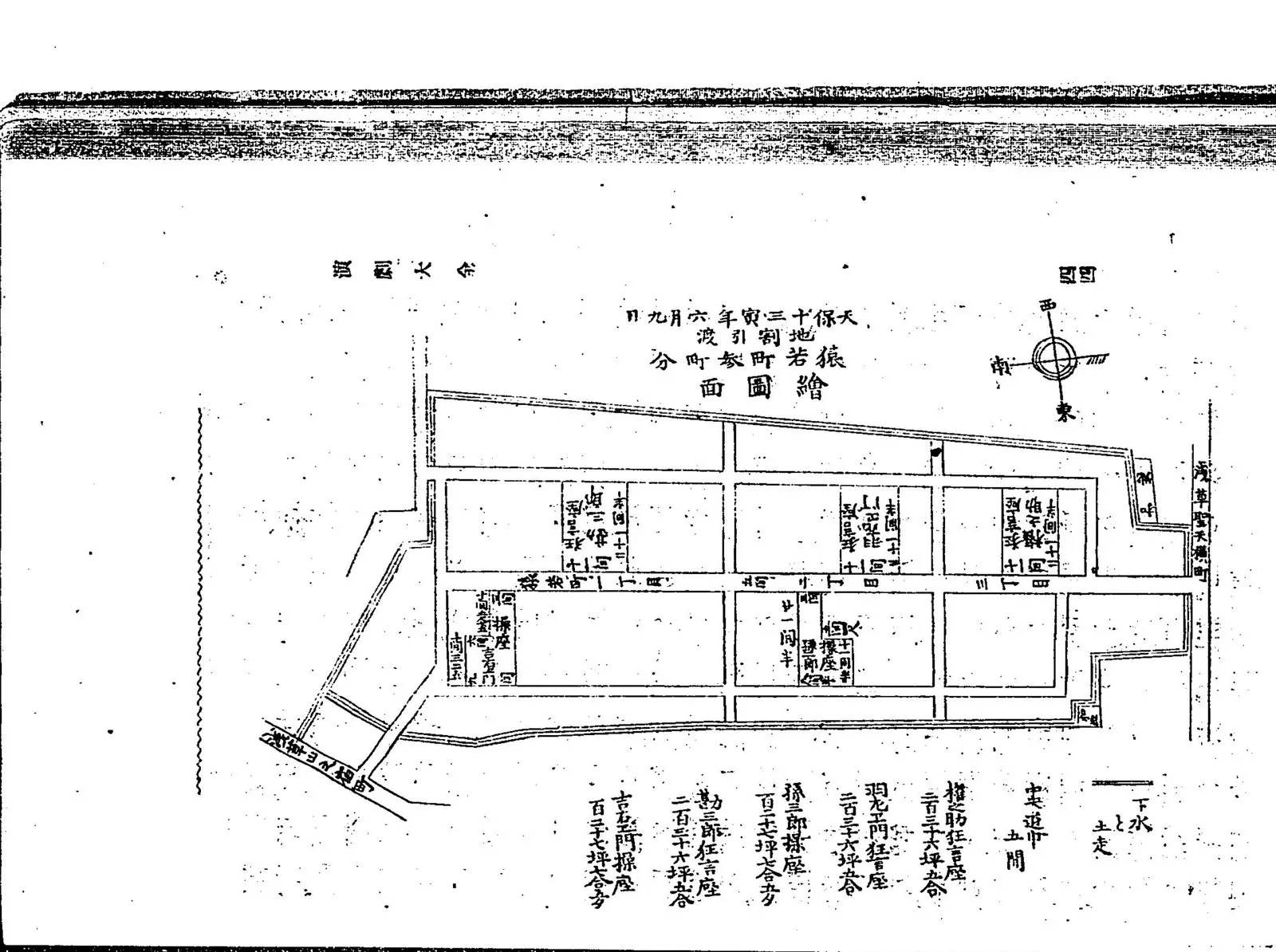
The lot map “Tenpō 13, Year of the Tiger, sixth month, 9th day / handover of lots / Saruwakachō, three blocks,” from Engeki Taizen (Sekine Mokuan, Naigai Shuppan Kyōkai, 1906). Reproduced from the National Diet Library Digital Collections (out of copyright) dl.ndl.go.jp/pid/991807. The original is printed turned 90 degrees; it is shown here upright. At the right edge is Asakusa Shōden-yokochō, and the compass rose marks that side as north. From the Shōden-yokochō side the blocks run 3-chōme, 2-chōme, 1-chōme — matching the monuments on site, where the Moritaza monument is the northernmost.
The Ichimuraza and Moritaza monuments both have “The Origins of the Three Saruwaka Theatres” carved on the back. As far as I could read them, the two texts are nearly identical, telling how Saruwakachō came to be and how the three theatres were laid out. One date is settled: the Moritaza monument was erected in May 1977 — eleven years after the town name disappeared. The side of the stone says it was put up by “a resident of 3-chōme since Taishō 13 (1924)” — someone from the very block where the Moritaza had stood (the name has weathered away). For the Ichimuraza monument, I have not yet found a date. Taitō ward’s tourism site says it was erected in 1964, which would make it a monument from two years before the town name disappeared — but until I confirm the inscription on site, that remains the ward’s account. Once I have looked at the back and the base, I intend to compare the texts on the two stones and settle the full wording of the origins.
The Saruwakachō monument has a date too: October 1974, with the name of the man who put it up, Niimi. That is three years before the Moritaza monument.
Below and to the left of that is one more line: “written by Kanisuke.” The same three characters seem to be signed, small, beside the title on the Moritaza monument as well. Kanisuke is Takeshiba Kanisuke (1904–89) — a house playwright at the Kabukiza who, while working backstage beating the wooden clappers, became the leading figure in reviving Kantei-ryū (the calligraphy style used for kabuki signboards and programmes), a style of theatre lettering that had been fading away. That is why the titles on the monuments are all in thick brushstrokes, like a theatre signboard. In 1974 Kanisuke was 69; in 1977, 72. The monuments of Saruwakachō, then, were lettered by the master of theatre lettering himself. The signatures on the two stones are the same three characters; the first is weathered, but its outline fits.
The map shows the Nakamuraza
I have been writing that “there is no monument to the Nakamuraza.” But was the Nakamuraza really there in the first place?
It was. A primary source draws it, by name.
The Edo kiriezu (a sectional map of Edo) Imado Minowa Asakusa ezu — by Tomatsu Masanori, published by Owariya Seishichi in Kaei 6 (1853) — includes the blocks of Saruwakachō. On it, the three theatres — the Nakamuraza, the Ichimuraza, and the Kawarasakiza — are drawn in a row, each with its name. (The map writes the last one 川原嵜座 rather than the usual 河原崎座: 川 in place of 河, and 嵜, with its 山 stacked on top, in place of 崎. The reading is the same.)
On the map, from the south (the Sensō-ji side), they run Nakamuraza, Ichimuraza, Kawarasakiza. The monuments on site — the Saruwakachō monument (on the 1-chōme side), the Ichimuraza monument, the Moritaza monument — run in the same order from south to north, going by the location data in my photos. The map’s compass rose puts north at the right of the original; in the rotated version shown here, north is at the left — the Kawarasakiza end is north, matching the monuments.
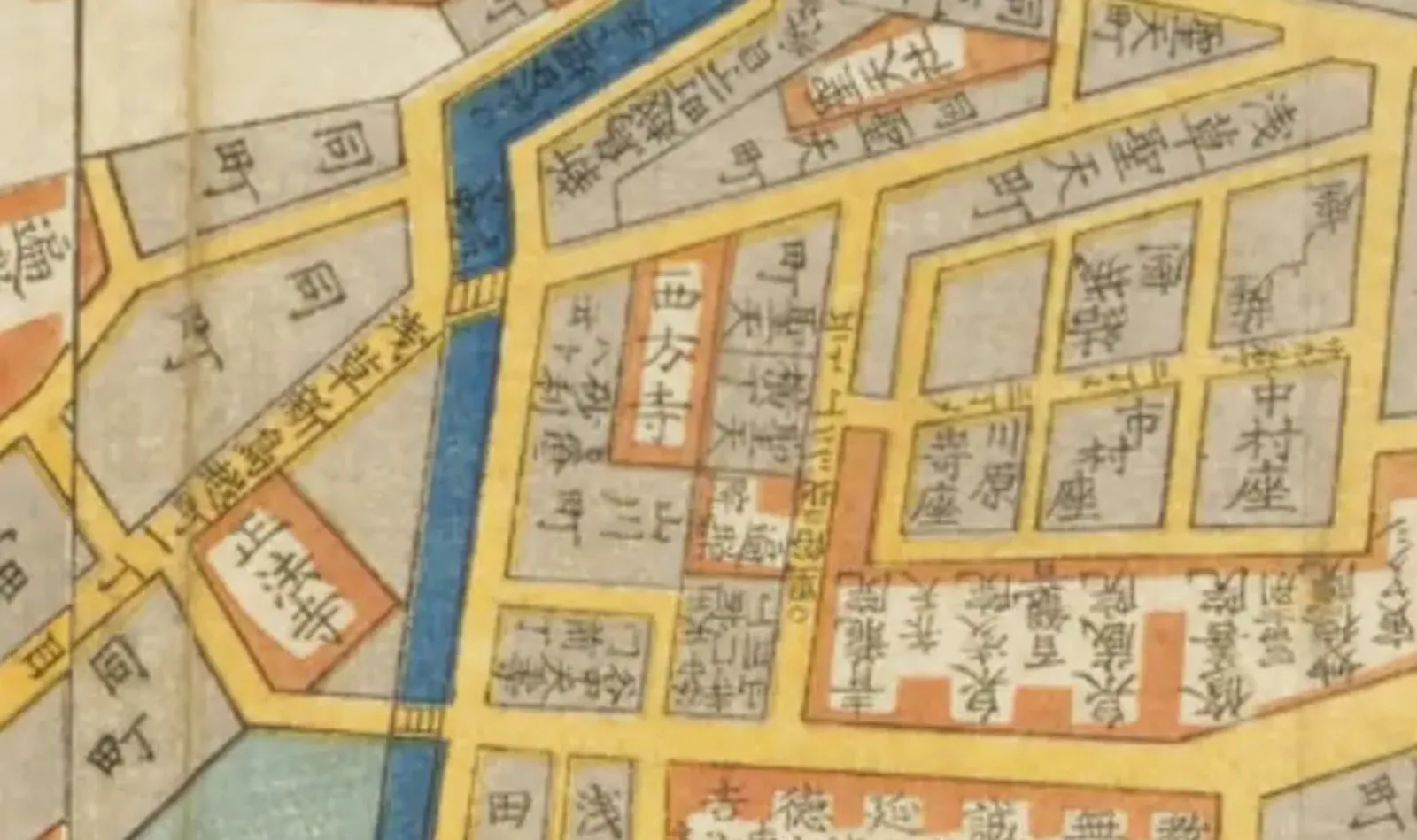
From right: the Nakamuraza, the Ichimuraza, the Kawarasakiza. The National Diet Library’s scan is upside down, so it is shown rotated 180 degrees; in this orientation, north is at the left.
[Edo kiriezu] Imado Minowa Asakusa ezu (Tomatsu Masanori, Owariya Seishichi, 1853). Reproduced from the National Diet Library Digital Collections (out of copyright) dl.ndl.go.jp/pid/1286208
This map settled one more thing.
The monument on site says “site of the Moritaza,” but the map says Kawarasakiza. What moved into Saruwakachō 3-chōme was the Kawarasakiza — the Moritaza’s hikae yagura (a reserve licence) — and the name Moritaza came from a later renaming; the origins text on the back of the monument itself says “the Kawarasakiza (later the Moritaza).” So the name on the monument and the theatre’s name at the time of the move do not match.
I also found out when the renamings happened. According to Engeki Taizen, the Moritaza became the Kawarasakiza in Bunka 1 (1804), when Kawarasaki Gonnosuke became its proprietor. It went back to being the Moritaza after the fire of Genji 1, and in Meiji 1 (1868) Morita Kan’ya rewrote the name: the first character of Morita changed from 森 to 守, while the reading stayed exactly the same.
Put in order: Moritaza 森田座 (Manji 3, 1660) → Kawarasakiza (Bunka 1, 1804) → Moritaza 森田座 again (after Genji 1) → Moritaza 守田座 (Meiji 1, 1868). The “Kawarasakiza” on the 1853 map is the correct name at the time, and the “Moritaza” on the monument is the name from fifteen years later.
To sum up: the map proves the Nakamuraza was there. It was there — and its monument alone is missing.
Where did the three theatres go? — Nichōmachi, Shintomichō, Torigoe
Saruwakachō’s life as a theatre district turned out to be surprisingly short. Once the Meiji era began, the three theatres moved back into the city one after another, and the town stopped being a theatre district. Follow each theatre to where it went, and you can put three points on the map of today’s Tokyo.
The Ichimuraza — Shitaya Nichōmachi
In 1892, the Ichimuraza moved to Shitaya Nichōmachi (today’s Taitō 1-chōme, Taitō ward). A signboard from the Taitō Ward Board of Education gives its history: founded in Fukiyachō, Nihonbashi, in 1634; moved to Saruwakachō 2-chōme in 1842; moved to Nichōmachi in 1892.
The Ichimuraza’s years there are remembered as the “Nichōmachi era” of Onoe Kikugorō VI and Nakamura Kichiemon I.
Nichōmachi is the birthplace of something else, too: Toppan Printing. Toppan Printing Limited Partnership was founded on January 17, 1900, at 1 Nichōmachi, Shitaya ward, Tokyo — today’s Taitō 1-chōme. The Ichimuraza had arrived in Nichōmachi in 1892, so a theatre and a printing company once shared the same neighborhood. The company’s head office building, which covers the area where the theatre stood, sits on that founding ground. And the company’s name changed from Toppan Printing to TOPPAN Holdings in October 2023, when it became a holding company.
So far this article has been nothing but names that keep changing. The Nakamuraza became the Saruwakaza, then the Torigoeza. The Moritaza became the Kawarasakiza, then the Moritaza again — with its new first character — then the Shintomiza. And in the same neighborhood, “Printing” dropped out of the printing company’s name, too.
That head office building is now being demolished, and when I went in August, I could not see the monument from outside the hoarding.
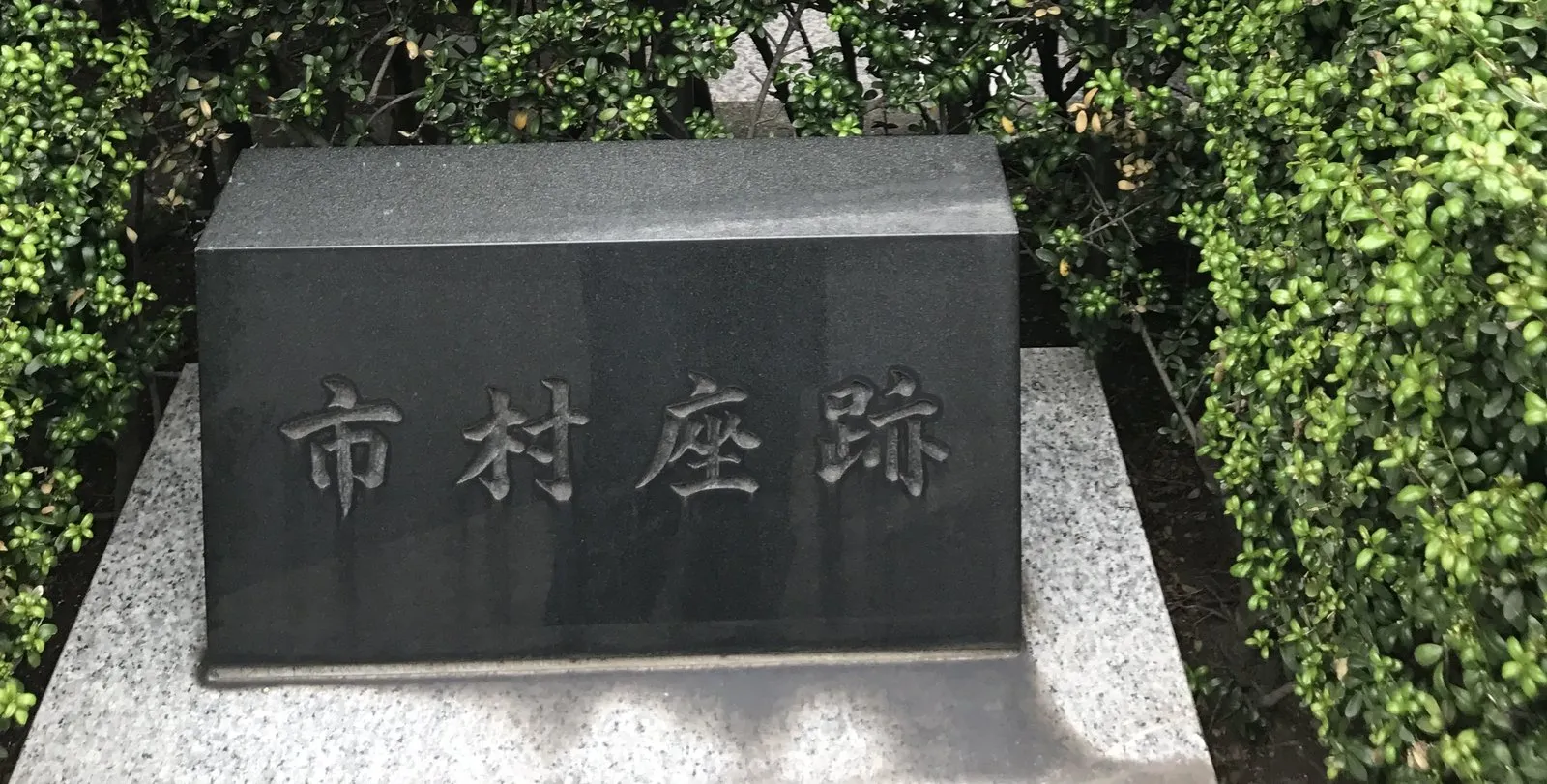
Nichōmachi before the demolition. In front of the planting stood a stone marked “Site of the Ichimuraza” (photographed May 12, 2017). Right behind it stood the Taitō Ward Board of Education signboard — the one that gives the Ichimuraza’s history quoted above.
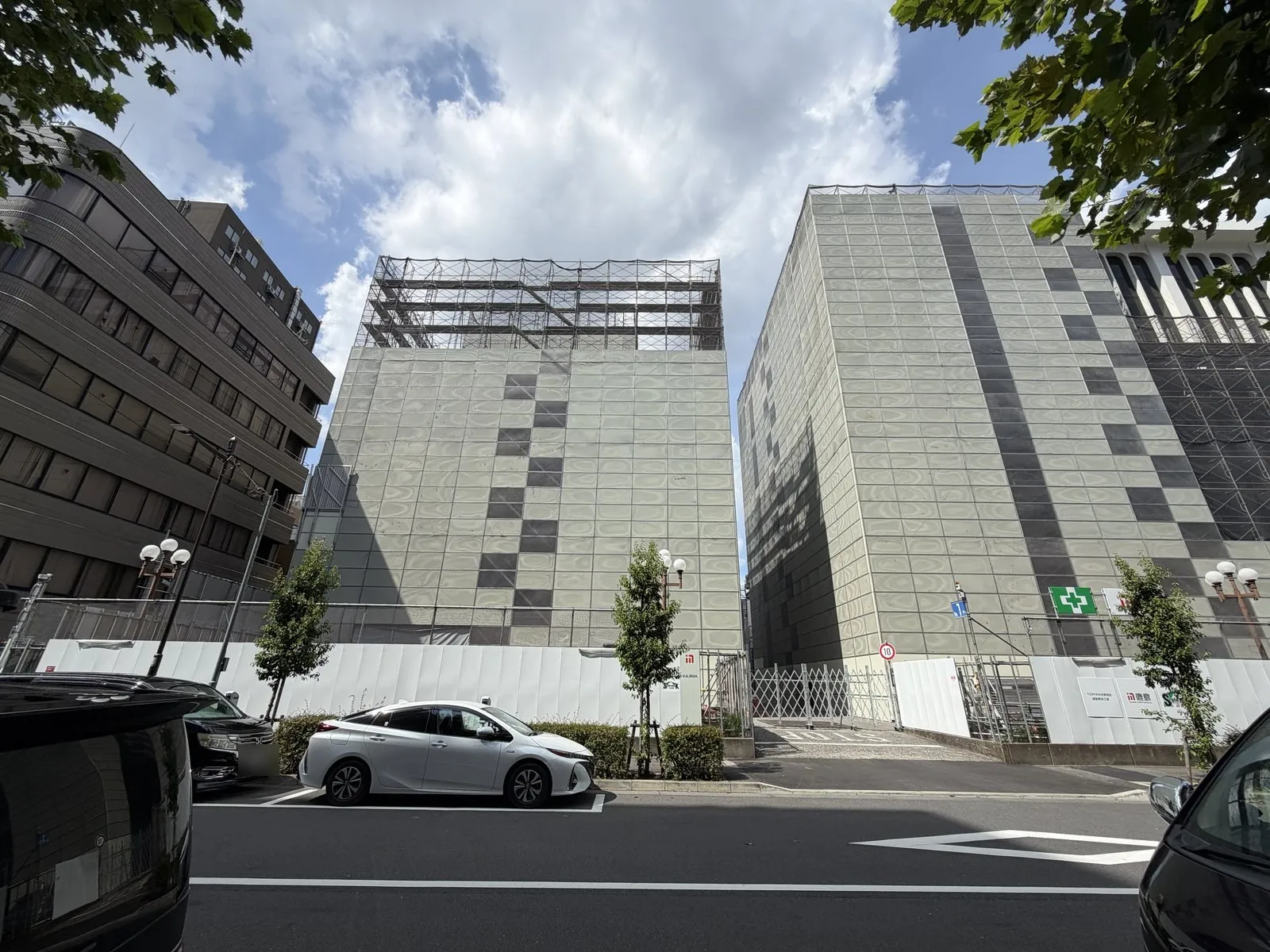
The same spot (photographed August 9, 2026). The monument is still inside the white wall in front. The signboard has been removed.
I have been photographing this demolition from a fixed point. The two photos above come from that record. It is a street I walked for years, so I cannot help shooting it before and after the hoarding went up, from the same angle.
Going to look at a monument to confirm it is “not there” is one thing; watching something “go missing” on a street you know well is another. It is the same “not there,” but it has a different texture. The Nakamuraza in Saruwakachō had been gone since long before I was born. The Ichimuraza monument in Nichōmachi was one I saw every time I passed.
So when I passed by again in September, the monument was still there.
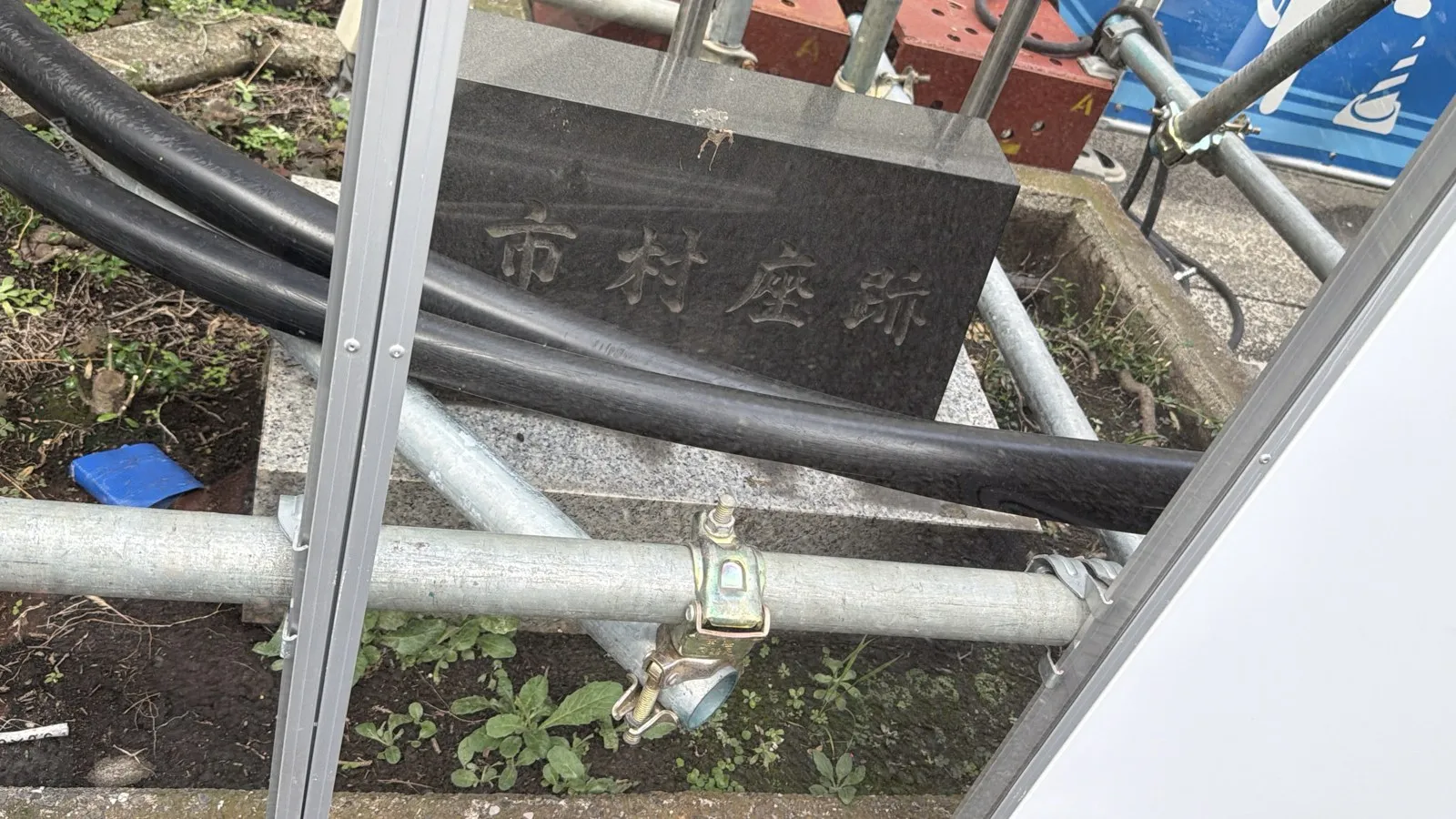
The “Site of the Ichimuraza” monument, left in place inside the hoarding (photographed September 5, 2026). Part of the hoarding is transparent, so it can be seen from outside.
Inside the construction wall that runs all the way around the site, the monument had been left where it was. And part of the wall is transparent, so you can see it. Someone decided that the monument should stay visible, even during construction. The signboard, though, has been removed.
The monument had not disappeared. The Nakamuraza’s monument is absent from Saruwakachō; the Ichimuraza’s monument is kept visible even in the middle of a construction site. The same kind of monument, treated very differently.
Where the monument will go once construction is over, I do not know yet. I am watching — and photographing, from the same fixed point.
The Moritaza — Shintomichō
In 1872, the Moritaza obtained permission to move to Shintomichō (today’s Shintomi 2-chōme, Chūō ward), and built its theatre there in the eighth month of that year. It took the name Shintomiza only in September 1875. Three years separate the move and the renaming.
Even then it did not settle down. A new building was completed in 1879; in November 1880 it became the “Shintomi Theatre Company,” which was dissolved in 1882. In 1894 it was the Shintomiza again; in 1896, the Miyakoza; and as of 1906, the Shintomiza once more — the name kept going back and forth.
The site is now a building housing the Kyōbashi Tax Office and the Tokyo Metropolitan Chūō Tax Office. On the sidewalk in front stands an explanatory signboard put up by the Chūō Ward Board of Education in August 2020. Printed on it is a Meiji-era woodblock print, “Assembly of All the Actors: The Prosperity of the Shintomiza, the Finest Theatre in Tokyo” (from the collection of the ward’s local history museum), with the great actors of the day lined up in front of the Shintomiza.
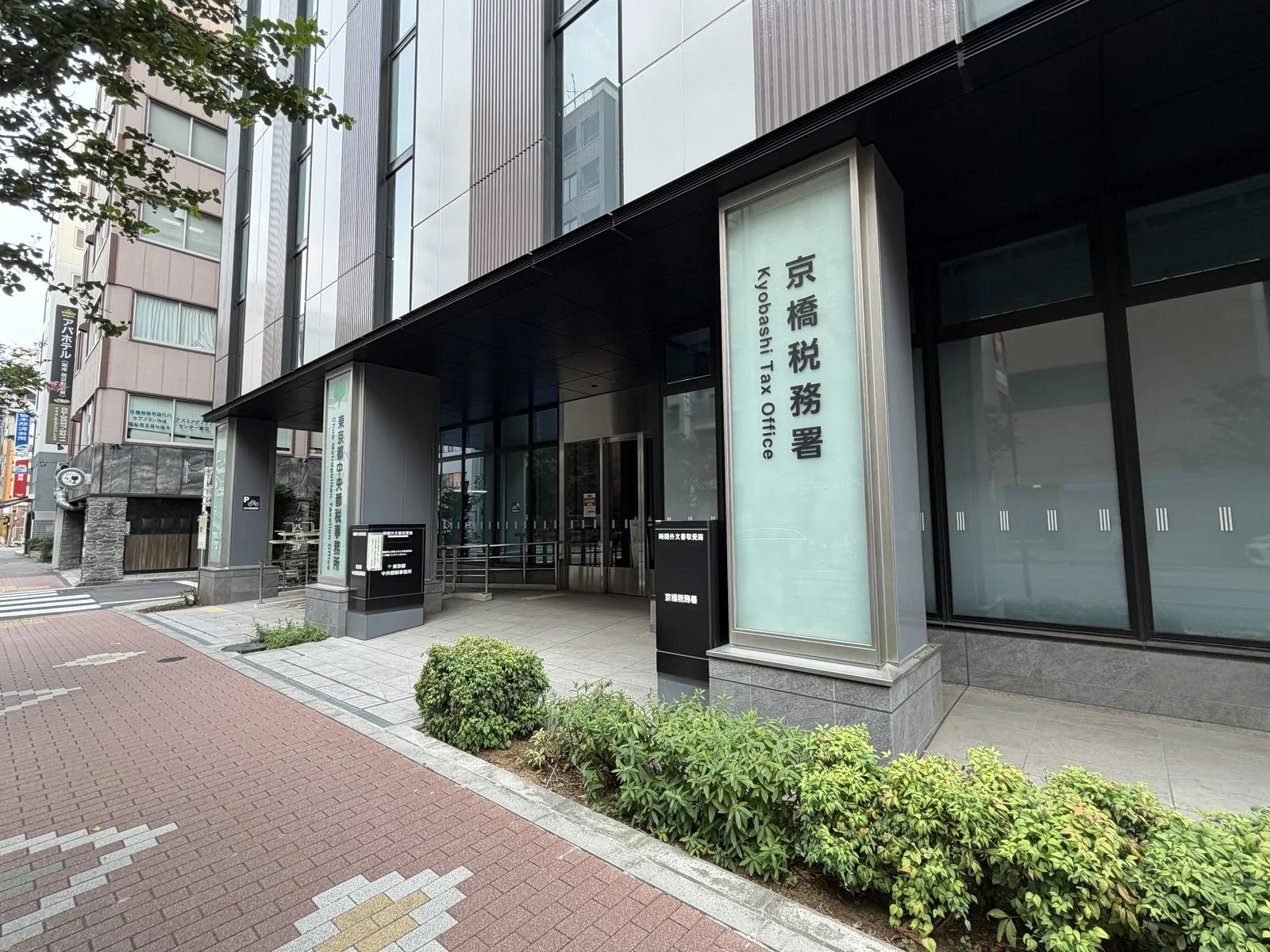
The site of the Shintomiza (Shintomi 2-chōme, Chūō ward). Photographed August 9, 2026.
I come to this neighborhood once a month. My hair salon is in Shintomichō.
Reading this signboard, I found another discrepancy.
The signboard says the Moritaza took the new character 守 in 1858 (Ansei 5). Engeki Taizen, on the other hand, says the change came in 1868 (Meiji 1), when the proprietor took the same character into his own name, becoming Morita Kan’ya. Ten years apart.
Which is right, I cannot decide for now. So I am writing both.
The signboard gave me something, too. Kobikichō 5-chōme, where the Moritaza originally stood, is today’s Ginza 6-chōme, it says. And the signboard’s English side takes the trouble to point out that changing 森 to 守 did not change the reading — “pronunciation remains unchanged,” in its words. It was a renaming in which only the character changed.
The Shintomiza later burned down in the Great Kantō Earthquake of 1923.
The Nakamuraza — Torigoe
And now, the Nakamuraza.
What remains of the Nakamuraza’s Meiji years is in Okazu Yokochō, a shopping street in Torigoe. But it is neither a ward signboard nor a monument. It is a handwritten sign by the owner of a pickle shop.
At the left edge of a wooden board lettered large with “Aji no Hikyaku — Gunji Miso Pickles,” it says, in small characters:
Former Asakusa Nishi-Torigoe — site of the Saruwakaza – Nakamuraza – Torigoeza The owner
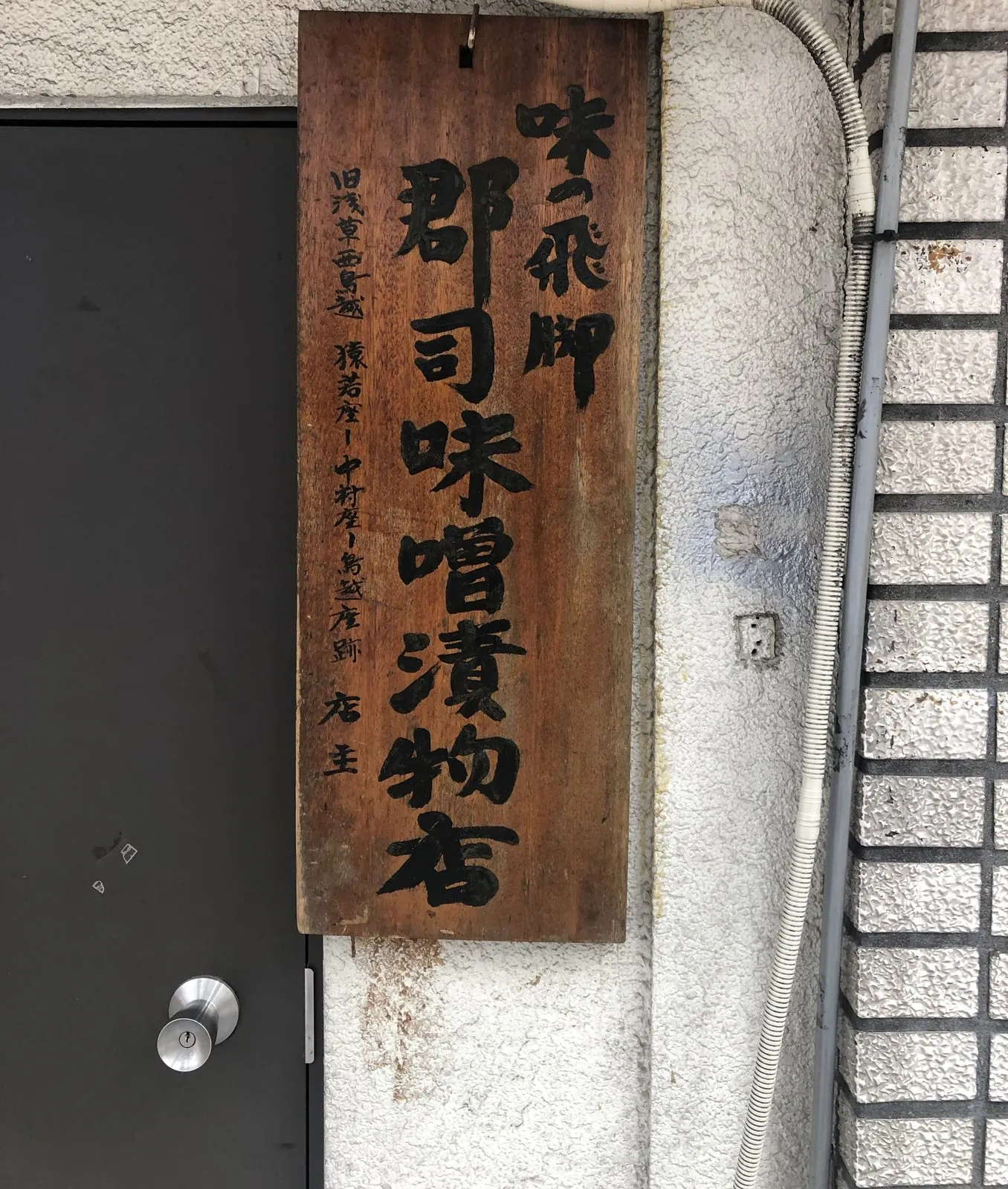
The handwritten sign at Gunji Miso Pickles, Okazu Yokochō (photographed May 5, 2019). At its left edge, in small characters: “Former Asakusa Nishi-Torigoe — site of the Saruwakaza – Nakamuraza – Torigoeza,” and below that, “The owner.”
It gives no dates — just three theatre names in a row. This September the shop front had been redone, but the same sign still hangs there.
A private handwritten sign as the only evidence is admittedly shaky. So I read the Nakamuraza entry in Engeki Taizen — and there it was.
- March 1878: renamed the Miyakoza
- March 1879: Kumesaburō, adopted son of Iwai Hanshirō, becomes proprietor, and the name goes back to the original Saruwakaza
- February 1883: the heir, Nakamura Akashi, becomes proprietor; on December 28 of that year the theatre moves to 2 Nishi-Torigoechō, Asakusa ward
- October 1884: the new building is completed; first performance on November 21. Frontage 13 ken, depth 25 ken (about 24 by 45 meters)
- 1885: burns down; afterwards becomes the “Torigoeza”
- 1893: burns once more and closes for good
The sign’s “former Asakusa Nishi-Torigoe” matches “2 Nishi-Torigoechō, Asakusa ward.” “Saruwakaza” is the renaming of 1879; “Torigoeza” is the name from 1885 on — both ends check out.
The “Nakamuraza” in the middle does not appear in Engeki Taizen, but it turned up in another book: “Tōto Gekijō Enkakushi,” part 4 of Shibai Sōshi (1917) — the writings of Sekine Shisei, father of Engeki Taizen’s author. Its entry for the fourteenth head of the house reads: “The fourteenth, Nakamura Akashi — theatre name changed from Nakamuraza to Torigoeza — true son of the thirteenth Kanzaburō — succeeded October 1883.” The two books do disagree on when the move happened, though (Shibai Sōshi: spring 1884, opening that November; Engeki Taizen: December 28, 1883, first performance November 21, 1884).
So all three names check out. A private handwritten sign had folded a lineage that spans two books into a single line — no dates, no sources.
And then the final line lands. As of 1906, the author of Engeki Taizen writes that there had been talk of rebuilding on an empty lot of the Tokugawa estate at Asakusa Daichi, but that to this day it has not been rebuilt.
In other words, the Nakamuraza ended with the fire of 1893 and was never rebuilt. I have been going on about a missing monument in Saruwakachō, but the Meiji Nakamuraza never got its theatre back at all.
Okazu Yokochō is the street I take my child along to daycare every day. So I pass this pickle shop every day too — it is my child’s favorite shop, and we buy there often. Once I asked, casually, about the theatre, but the staff member who served me did not seem to know much about it. Next time, I plan to ask the owner.
Set side by side, the contrast is plain. The Ichimuraza and the Moritaza have public monuments and signboards; the Nakamuraza has only a shop owner’s handwritten sign. The one theatre with no monument in Saruwakachō has no public commemoration at its Meiji destination either.
Only one theatre went home
Think back to where the three theatres started: Nakamuraza = Sakaichō, Ichimuraza = Fukiyachō, Moritaza = Kobikichō. All three are in what is now Chūō ward.
After the Moritaza became the Shintomiza in Shintomichō, a new theatre went up in Kobikichō in 1889: the Kabukiza. Planned by Chiba Katsugorō and Fukuchi Ōchi, it was begun in April of that year in Kobikichō 2-chōme, Kyōbashi ward, and finished in a little over eight months.
Here I want to be precise. The original home of the theatre that moved to Saruwakachō 3-chōme was Kobikichō 5-chōme — according to the Chūō ward signboard, today’s Ginza 6-chōme. The Kabukiza, on the other hand, is in Kobikichō 2-chōme — today’s Ginza 4-chōme. Same town, different block. Not close enough to say it “went back to the same spot.”
Even so, you can draw a circle. The Moritaza’s line, driven out of Kobikichō by the Tenpō Reforms, breaks off in Shintomichō — but theatre itself came back to Kobikichō, where it had started, forty-seven years later. Seeing a play at the Kabukiza today means seeing it in the same town as the theatre district from before the three theatres of Edo were driven out.
And there is more. The Kabukiza’s stage curtain follows the Moritaza’s pattern.
The jōshiki-maku (the striped stage curtain) is the curtain drawn at the start and end of a play, striped vertically. Each theatre had its own order of colors, and the Kabukiza’s is green, persimmon, and black — the Moritaza’s pattern. The Nakamuraza, by contrast, used persimmon, white, and black. Incidentally, this site’s color scheme is taken from that Nakamuraza black, white, and persimmon. The Kabukiza’s order is a registered trademark of Shōchiku, so this was the one to borrow — and it suits a site whose author lives near an old Nakamuraza site.
There is a story behind the Nakamuraza’s three colors. When the shogunate’s great ship, the Atakemaru, came into port, the first Saruwaka Kanzaburō stood at its prow, waving a baton and leading the chant, and brought it safely in. As a reward he was given the curtain that covered the ship, and from it he devised the three-colored stage curtain — or so it is said.
So the Kabukiza carries on the Moritaza’s side, in both place and curtain colors. Of the three theatres, only one went back to where it began — and it even brought its colors home.
And the Nakamuraza came back to Asakusa — the Heisei Nakamuraza
And in the autumn of 2026, the Nakamuraza name came back to Asakusa.
From October 1 to 25, 2026, the Heisei Nakamuraza played in Asakusa — a run in a temporary theatre built on the grounds of Sensō-ji temple, its first time in Asakusa in four years.
The Heisei Nakamuraza began in 2000. Nakamura Kanzaburō XVIII (then Kankurō V) wanted to build a playhouse full of the bustle of the Edo period, and put up a temporary theatre in Asakusa. It opened that November at Sanyabori, in Sumida Park. In other words, it was born in Asakusa, too. And its yagura rose again on the grounds of Sensō-ji, just a few hundred meters from Saruwakachō.
And there is a monument here. Near the site of Imado Bridge in Sumida Park stands a monument to “the Birthplace of the Heisei Nakamuraza,” carved with the record that the Heisei Nakamuraza came into being here at Sanyabori in November 2000, and that its first program was Sumidagawa Gonichi no Omokage: Hōkaibō. It was erected in March 2015 — so the side of the stone says (some web records give April, but I go with the inscription). It is a few minutes’ walk from the three theatre sites in Saruwakachō. The Edo Nakamuraza has no monument in Saruwakachō; the Heisei Nakamuraza has one in the park just beyond. For someone who came to count monuments, that feels like irony — and also like a sequel.
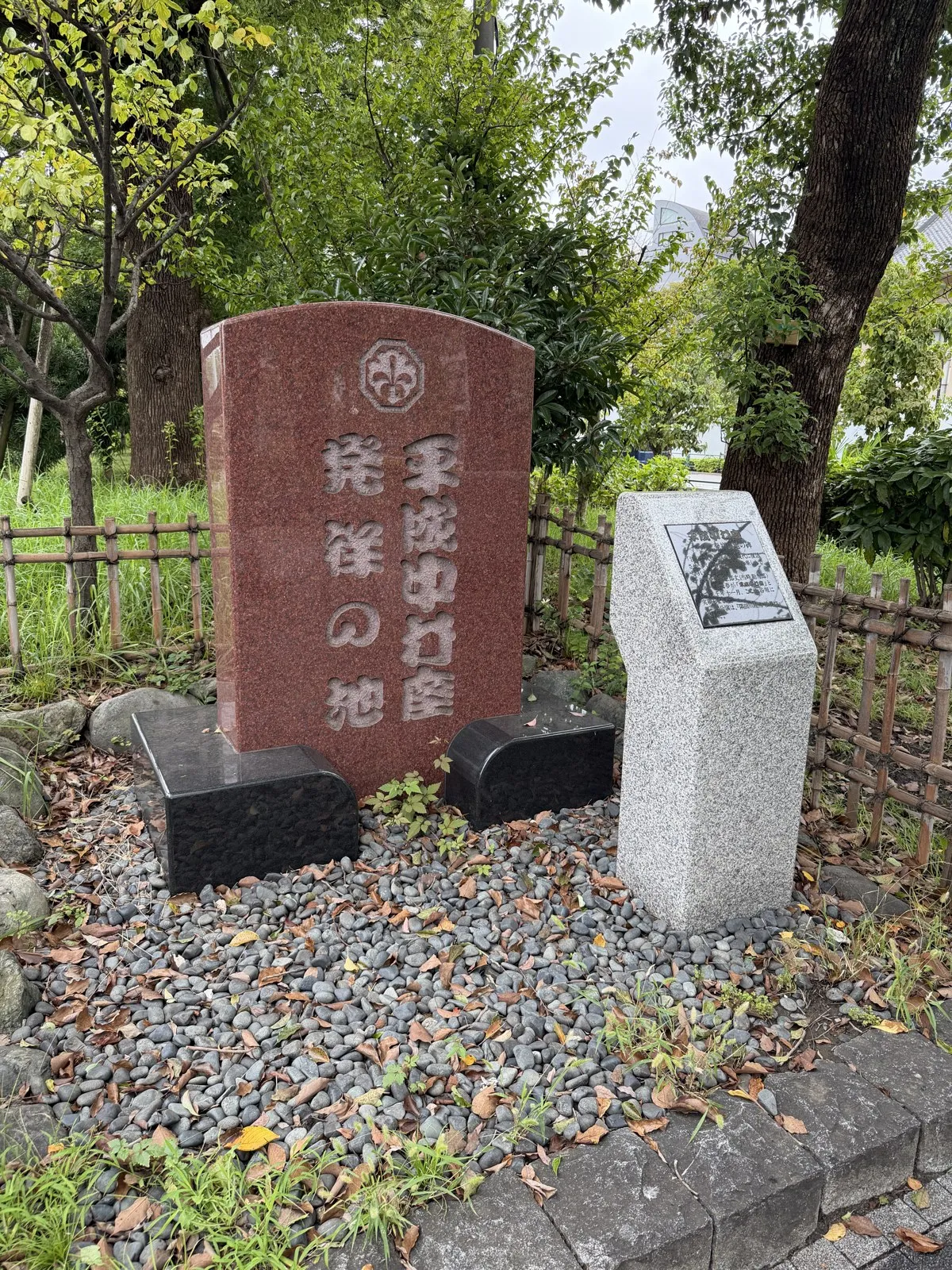
The “Birthplace of the Heisei Nakamuraza” monument (Sanyabori Plaza, Sumida Park; photographed September 13, 2026). The white pillar on the right carries the plaque. The side of the monument is carved “An auspicious day in March, Heisei 27 (2015) — Committee for the Heisei Nakamuraza Birthplace Monument.”
The program has a connection, too. The second part featured Gozonji Suzugamori and Sukeroku Kuruwa no Hatsuzakura — Sukeroku. A play about a man from the days when narrow chokibune boats plied the Sanyabori canal, staged in a playhouse right beside Sanyabori.
Here, let me tell you about a play I saw nine years ago. February 4, 2017, at the Kabukiza: the Saruwaka Festival February Grand Kabuki, daytime program. The first piece was Saruwaka Edo no Hatsuyagura — “Saruwakaza, the First Kabuki Theatre in Edo,” to use the English title the theatre has given it.
New Year in Edo. Izumo no Okuni — with whom kabuki is said to have begun — and Saruwaka’s troupe, who have made their name in Kyoto, come down to Edo. Saruwaka rescues Fukutomiya, a timber merchant, and his wife, who have been set upon by thugs and cannot get their cart moving; he leads the chant himself and has the young men haul it. The magistrate Itakura Katsushige, who has been watching, calls Saruwaka and his troupe over, hears that they are looking for a place to perform in Edo, and gives them permission to build a playhouse at Nakabashi, near Nihonbashi. That is the dance play. In other words, the very moment a playhouse is born has been made into a play.
Saruwaka was danced by the present Nakamura Kankurō, and Okuni by his younger brother, Shichinosuke. Saruwaka, danced by the present generation of the Nakamuraya — the acting house that carries on that name — in a month billed as the “Saruwaka Festival.”
(Earlier, in the part about the stage curtain, I mentioned the legend of the first Kanzaburō leading the chant from the Atakemaru’s prow. In this dance, too, Saruwaka leads the chant to haul a cart. Saruwaka as the man who leads the chant — the image overlaps in the legend and in the play.)
One caution: Izumo no Okuni’s trip to Edo is not historical. The theatre program itself says so, explaining that the piece stands for kabuki’s journey from Okuni to Edo. Sometimes the play is the more honest one.
What I thought while watching was: this must be enormous pressure. On stage, the role announces “we are the founders” — and it is danced by the very people who inherit that name. And Kankurō and Shichinosuke were young at the time.
And I live in the city that was Edo, and I can still watch the kabuki that began in that same Edo. Put in writing, it sounds obvious, but I think it is remarkable. I started this site in the first place because I realized I had been walking this land before I ever knew kabuki.
There is no monument to the Nakamuraza in Saruwakachō. But in October 2026, in place of a monument, a real playhouse stood in Asakusa. Right near the place where I looked for a monument and found none, a yagura went up.
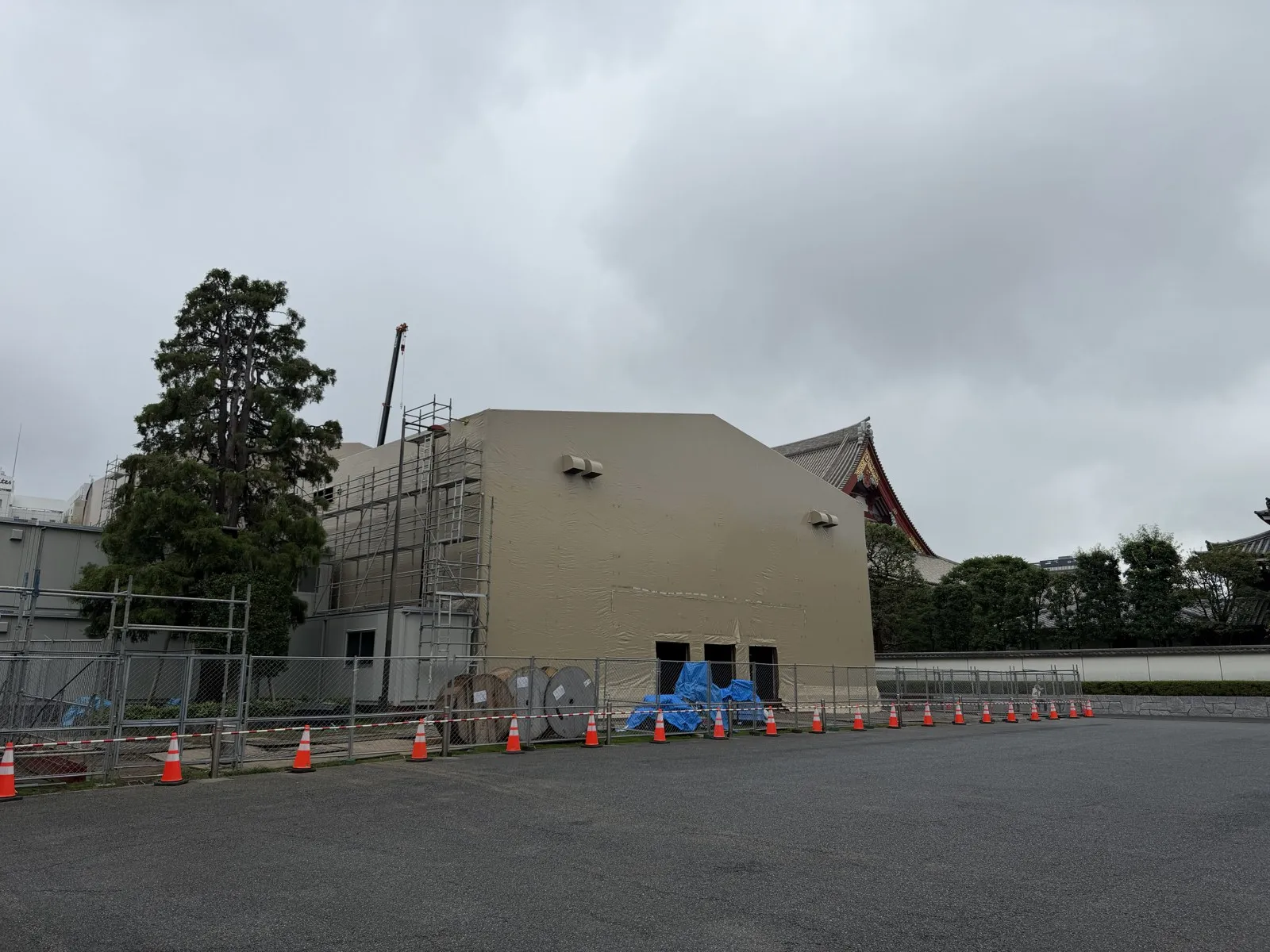
The temporary theatre assembled behind the Main Hall of Sensō-ji (photographed September 13, 2026, day 13 of construction). Seen from the parking lot on the west side, which is the back of the building. The outer walls are sheeted, and the roof of the Main Hall shows behind. The front was still an open construction bay with a crane, and I did not photograph it. The yagura is not up yet. According to the building-plan notice on site, construction began September 1 and was due to finish September 24. It is a steel-frame “temporary performance hall,” resting on foundations laid on the surface rather than sunk into the ground.
Tickets sold out early through the Japanese box office. But Shōchiku’s official English-language ticketing still had a separate allocation, and there I got a take (“bamboo”) seat for the second part on October 3.
I saw the second part on October 3
And on October 3, I saw that second part.
The playhouse I had been following since it was going up stood finished, and fine — it moved me. Round at the front, which in September I could not photograph for the construction, the yagura was up.
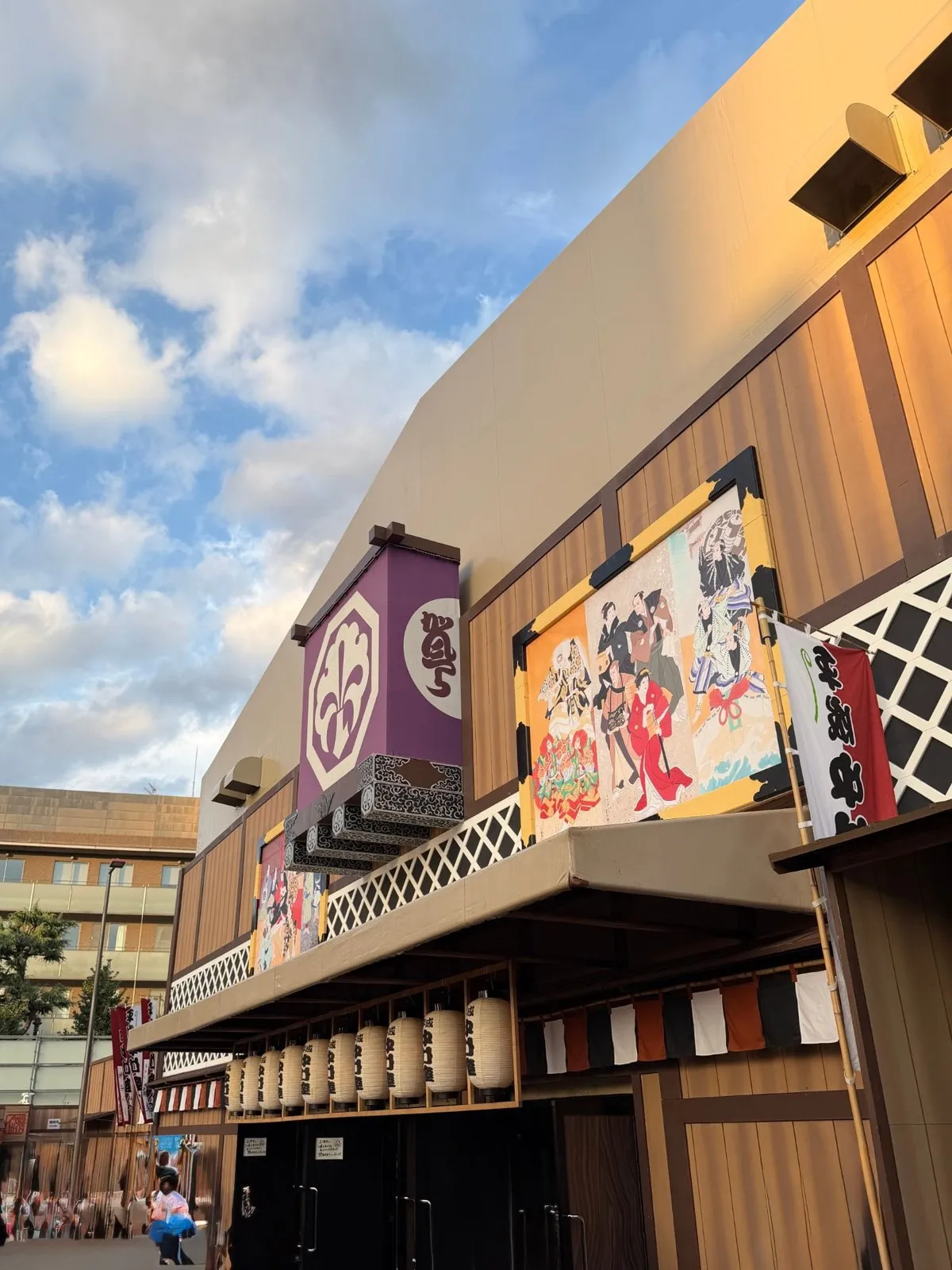
The front of the Heisei Nakamuraza (photographed October 3, 2026, during an interval). A purple yagura with the theatre’s crest, and a painted signboard beside it. The faces of passers-by have been removed.
Inside, photography was actively encouraged. Only the stage during a performance is off-limits; the playhouse recreates one from the Edo period, so take lots of pictures, we were told.
In the corridor hung a poster from the Saruwaka Festival at the Kabukiza in February 2017: Kadode Futari Momotarō — the stage debut of Nakamura Kantarō III and Nakamura Chōzaburō II. It was the same Saruwaka Festival month in which I saw Saruwaka Edo no Hatsuyagura, as I wrote above, and I saw this Momotarō too, in the evening program the next day.
That same Kantarō was playing Shirai Gonpachi in Suzugamori that day. Kantarō, look how you’ve grown — that was my first thought. The last time I saw him he was Momotarō, and now he is a fine actor in his own right. It moved me.
The second half was Sukeroku. Seeing Sukeroku in Asakusa made me happier than I can say. If I had to explain it to a friend who has never seen kabuki, it would be this: it is your favorite work, staged for real, in the very place it is set.
The play itself — Sukeroku plunging into real water in the mizuiri scene, the audience roaring at the dandy crawling between Sukeroku’s legs — I wrote about in my theatre diary, which is in Japanese.
It is not only the monuments that don’t add up
I have the program from that February 2017 right here. Its cover carries this heading:
390 Years of Edo Kabuki
A nice number. Or so I thought, until I did the subtraction.
2017 − 390 = 1627. But Edo kabuki is generally dated from Kan’ei 1 — 1624. Engeki Taizen says the same: in the second month of Kan’ei 1, Kanzaburō, son of Saruwaka Kangorō, petitioned and received permission, called his theatre the Nakamuraza, and gave the first performances at Naka-no-mura (later Nakabashi) — the beginning, it says, of kabuki performed by men. Three years off.
When numbers don’t add up, it is usually my own mistake. Thinking so, I read on in the program — and the program had already owned up. It says plainly that the count holds back by about three years. It is not an error: it is a number rounded on purpose.
Checking further: the same Saruwaka Edo no Hatsuyagura was first staged in January 1987, under the heading “360 Years of Edo Kabuki.” 1987 + 30 = 2017, and 360 + 30 = 390 — exactly thirty years apart, and they line up. The count from 1627 held for at least those thirty years.
And there is someone else counting: the shogunate.
Remember Tōyama Saemon-no-jō’s memorandum. Its first article answers the order to “look into how the three theatres were founded,” and Tōyama, after investigation by his office, reports as follows (words in [ ] are supplied from the end of the previous page):
[Kanzaburō of Sakaichō]: his theatre has been carried on for 218 years; Uzaemon of Fukiyachō, for 178 years; Gonnosuke of Kobikichō, for 182 years
The memorandum’s year is Tenpō 12, which corresponds to 1841. (Its last month ran into January 1842, as noted above, but the count here is by era years.) Take Tenpō 12 as the 218th year and count back: 1841 − 218 + 1 = 1624. Kan’ei 1. Check it against Kobikichō’s 182 years and you get 1660 — which matches Engeki Taizen’s founding date for the Moritaza, “Manji 3,” or 1660.
So as of Tenpō 12, the shogunate was counting the Nakamuraza from Kan’ei 1. The town magistrate’s office looked into it again and reported “no discrepancy,” so as evidence it is fairly solid. Shōchiku’s count from 1627 is three years off from the shogunate’s own reckoning, too.
Edo rounded its numbers too
Why hold back? That I still do not know. But I did find out that rounding itself goes back to Edo. Sekine Shisei’s Tōto Gekijō Enkakushi records two instances.
The first: in An’ei 2 (1773), when the Nakamuraza staged a kotobuki kyōgen (a congratulatory production) to celebrate its years, the banner set up beside the theatre was dyed with “Kan’ei 1, Year of the Rat, second month, 15th day: men’s kabuki first performed — to An’ei 2, Year of the Snake: 150 years.” Count 1624 as year one, and 1773 is exactly the 150th year. It checks out perfectly.
The second is the interesting one. In the fifth month of Bunka 15 (1818; the era was renamed Bunsei in the fourth month of that year, but I keep the source’s wording), the Miyakoza handed out printed notices and playbills all over Edo, billing its program as a “kotobuki kyōgen.” The signboard it meant to put up read “Miyako Dennai’s 200th-Year Kotobuki Kyōgen,” and its formal announcement said:
Since our ancestor received licence in the Kan’ei era and began performing in this city, our theatre reaches its 195th year; we therefore celebrate the 200th year in advance and stage a kotobuki kyōgen
It was the 195th year, and they tried to “celebrate the 200th in advance.” Five years early. But three former theatre proprietors objected, the ward headman in charge asked the town magistrate’s office for a ruling, and on the grounds that it could be mistaken for a hanakai (a gathering where patrons brought gifts of money), it was stopped, and they were reprimanded. The outcome:
The play itself was performed, but only the words “200th-year kotobuki” were taken out, and no congratulatory gifts were accepted
They were allowed to put on the show, but the words “200th-year kotobuki” had to go. (At the start of its account the book calls this the “300th-year kotobuki kyōgen,” while the signboard and the announcement say “200th.” I quote the original as it stands, without deciding which is wrong.)
Here too, 1818 − 195 + 1 = 1624. Kan’ei 1, again.
All three count from 1624
| Year | What | Years claimed | Starting year, counted back |
|---|---|---|---|
| An’ei 2 (1773) | The Nakamuraza’s kotobuki kyōgen banner | 150 | 1624 |
| Bunka 15 (1818; Bunsei 1 after the era change) | The Miyakoza’s announcement (195 years, “celebrated in advance” as 200) | 195 | 1624 |
| Tenpō 12 (1841) | Tōyama Saemon-no-jō’s memorandum | 218 | 1624 |
All three, counting their own year as year one, land on 1624. Edo’s theatres and the shogunate alike counted from Kan’ei 1. Counted the same way, 2017 was the 394th year. The Miyakoza called 195 years 200 and was reprimanded; Shōchiku calls 394 years 390. The direction is opposite, but the habit of pulling toward a round number is the same. That said, it is only a resemblance — it does not explain why the count was kept low.
The one that doesn’t fit is Fukiyachō’s 178 years. 1841 − 178 + 1 = 1664 — thirty years off from Kan’ei 11 (1634), the year the Ichimuraza is usually said to have been founded. The same Tōto Gekijō Enkakushi supplied the answer. Its entry on the Ichimuraza’s founder, Ichimura Uzaemon, says he served “from Jōō 1 to Kanbun 4 — thirteen years”: the founder’s time as proprietor ended in Kanbun 4, that is, 1664. So the memorandum’s 178 years leaves out the founder’s generation and counts the succession of the Uzaemons who came after him. The Nakamuraza and the Moritaza are counted from their founding, the Ichimuraza from the founder’s successor — the counting is not consistent within a single memorandum, and yet the shogunate reported “founding dates and so on: no discrepancy.”
And Shōchiku had recounted
Having written this far, I carried the subtraction one step further. If Shōchiku’s count continued, 2027 would be “400 Years of Edo Kabuki.” With that in mind I went through past Saruwaka Festivals — and it had already been celebrated.
The Saruwaka Festival February Grand Kabuki at the Kabukiza in February 2024 — a memorial production for Kanzaburō XVIII — proclaimed “400 years since Kan’ei 1 (1624), February 15, when Kanzaburō I first raised a yagura in Edo.” In his stage announcement on opening day, Kankurō said this year marked 400 years, counting from Kan’ei 1. Saruwaka Edo no Hatsuyagura was on the evening program, too.
1624 + 400 = 2024. The starting point is Kan’ei 1. 1987 and 2017 counted from 1627, so in seven years the count moved forward by ten. By 2024, the three years of holding back were gone. Why they held back, and why they stopped, I still do not know. But since the announcement put the starting point into words — “counting from Kan’ei 1” — Shōchiku’s count today is the same as the shogunate’s memorandum. (I did not see the 2024 performances, so I have not checked the heading on the program cover; this rests on the performance page and a report on the opening-day announcement.)
I counted the monuments and came up one short; I counted the years and found them three off — and somewhere along the way, they came right. Around this town, numbers that don’t add up don’t stay that way.
“Never there,” or “lost”?
Finally, let me sort out the homework.
Was the Nakamuraza’s monument never built, or built and later lost? Since it is not on the ward’s list of landmarks, I cannot confirm either one for now.
But what I wanted to do in this article was not to pry into whether a monument exists. It was to sort out the theatres’ moves with my own hands. From Sakaichō, Fukiyachō, and Kobikichō to Saruwakachō. From Saruwakachō to Torigoe, Nichōmachi, and Shintomichō. Trace the history of these moves, and you can put points all over today’s Tokyo. Monument or no monument, the points can be placed.
Let me list only what is known. The 1853 map shows the Nakamuraza. There are three monuments on site, and none of them is the Nakamuraza’s. At Torigoe, where it moved in the Meiji era, there is only a handwritten sign. And in October 2026, a temporary theatre that carries on the Nakamuraza name stood a stone’s throw from Saruwakachō.
Having no monument and having no memory are two different things.
Besides, playhouses are not a thing of the past. List the places in Tokyo where kabuki plays today: the Kabukiza (in Kobikichō — where the Moritaza started), the Shinbashi Enbujō, the Meijiza, and, at New Year, the Asakusa Public Hall (New Year Asakusa Kabuki). Add to those the Heisei Nakamuraza, for a limited time. Visiting monuments is fine, but walking into a living playhouse is, I think, the surest pilgrimage of all.
And the four hundred years had already been celebrated, in 2024. The three years of holding back had ended without my noticing. What will the heading say at the next Saruwaka Festival? That still gives me a reason to go and check.
That day was my first time on the street in Saruwakachō where the monuments stand. I have been along the main roads nearby many times. The blocks lately nicknamed Ura-Asakusa — “back Asakusa” — busy with places to eat and drink, are right next door. Even so, the monument street sits a little off to the side, and unless you have a reason to be there, it is not a place you end up. It is fifteen minutes from home by bicycle. It looked like rain, so I hurried home.
The pickle shop in Torigoe and the Ichimuraza site in Nichōmachi, on the other hand, were part of my life before I ever looked into them. Around the time I moved here, I was searching Google Maps for places to eat nearby, and learned that a miso shop had a sign about the site of a kabuki theatre. The Ichimuraza site is close by, too. I was deep into kabuki at the time, so I suppose it showed up on my radar. I did not know about counting them as “the three theatres.” Even so, I could tell that kabuki had put down roots in this area. I still think I moved to a good place.
A street I would not visit without a reason; the road I take my child along every day; a street I walked for years. Now that I have finished writing, all three turn out to belong to the same story of moving. Within a circle ten-odd minutes across by bicycle lie Saruwakachō, Torigoe where the Nakamuraza moved, and Nichōmachi where the Ichimuraza moved.
I wrote that you can put points all over today’s Tokyo. Those points lay right on top of my own daily life. Lord Matsuura’s residence site is within walking distance, too. That day, as well, I learned a good many new things. I get to walk my everyday streets counting history as I go. For someone who chases kabuki, that is, after all, fun. There are plenty more points still to put down.
Getting there
This section exists only in the English edition (see STRATEGY §8.5: practical information for visitors).
- The walk in the route box above starts at Asakusa Station, goes up Nakamise to the Main Hall of Sensō-ji and the Heisei Nakamuraza site behind it, then heads east through the three monuments of Saruwakachō and ends at the Heisei Nakamuraza’s birthplace monument near the Sumida River. It is about 2 km — roughly half an hour of actual walking, more if you stop at the temple.
- Stations: Asakusa (Tokyo Metro Ginza Line / Toei Asakusa Line / Tobu Skytree Line). The Tsukuba Express has its own Asakusa Station a little to the west; you can walk from there too.
- Coming from the Kabukiza: the Toei Asakusa Line runs direct from Higashi-ginza to Asakusa.
- The Heisei Nakamuraza’s 2026 run: October 1–25 only. Outside those dates, the spot behind the Main Hall is an open space. The Sensō-ji area is crowded at almost any hour.
- The three monuments of Saruwakachō stand on an ordinary residential street, within about 115 meters of one another. All three can be read from the road. The Saruwakachō monument is at the back of a parking lot — look from the street; there is no need to walk in.
- The other three points in this article are off the walk, each a separate trip:
- Nichōmachi (Taitō 1-chōme, Taitō ward): as of September 2026, the Ichimuraza monument stands inside construction hoarding, visible through a transparent panel. The ward’s signboard has been removed.
- Shintomichō (Shintomi 2-chōme, Chūō ward): the Chūō ward signboard for the Shintomiza stands on the sidewalk in front of the tax office building.
- Torigoe: the handwritten sign hangs at a working shop in Okazu Yokochō. It is a shop, not a monument.
- What is physically left is modest — three stone monuments on a residential street, a handwritten sign, a monument behind a construction wall. This article is the context that makes them worth standing in front of. In October 2026, a real playhouse stood there as well.
- Tickets: the Heisei Nakamuraza also sells through Shōchiku’s multilingual online ticketing (Shochiku Multilingual Online Ticket). When I booked in August 2026, it still had seats after the Japanese box office had sold out.
Sources (7)
The sources are those of the Japanese original, which this article was translated from; see the Japanese edition for the full list. In short: Engeki Taizen (Sekine Mokuan, 1906), Shibai Sōshi / Tōto Gekijō Enkakushi (Sekine Shisei, 1916–17), Nihon Engekishi (Ihara Seiseien, 1904), and the Imado Minowa Asakusa ezu (1853), all via the National Diet Library Digital Collections and out of copyright; the Kabukiza program for February 2017; Taitō and Chūō ward signboards and the monuments’ inscriptions, photographed and transcribed on site; TOPPAN’s corporate history; and Shōchiku’s performance pages.
Translation notes (differences from the Japanese original, per research/eigo-yakugo.md):
- Dates before 1873 are lunisolar. “The tenth month” is not October. Where a day is pinned down and the Gregorian date matters, it is given: the twelfth month of Tenpō 12 ran from January 12 to February 9, 1842, so the 2nd, 10th, and 18th of that month fall in January 1842, and its last day on February 9 (converted with the National Astronomical Observatory of Japan’s calendar database). Year arithmetic (“the 218th year”) counts era years, as the sources do.
- Kanji appear in the text only where the argument depends on the character itself: 堺町/境町 (Sakaichō), 河原崎座/川原嵜座 (Kawarasakiza), and 森田座/守田座 (Moritaza). Each pair reads the same. Their meanings are deliberately not translated — what changed was the character, not the sense.
- The Ichimuraza’s founder, Ichimura Uzaemon (宇左衛門), and the later heads of the house (羽左衛門) share the reading Uzaemon but not the characters. The argument does not turn on this, so it is noted here rather than in the text.
- Theatre names are written as one word, without a hyphen (Nakamuraza, Ichimuraza), following Shōchiku’s English site and the Taitō ward signboards.
- Traditional units are kept as romanized units with metric equivalents (ken, tsubo, chō), never converted to feet.
- Kotobuki kyōgen is glossed “a congratulatory production,” following Samuel L. Leiter’s kabuki dictionaries.
- Passages quoted from Edo- and Meiji-period sources are translated by this site. The February 2017 theatre program was used for facts only; its wording is not reproduced, and its English pages were not consulted.